
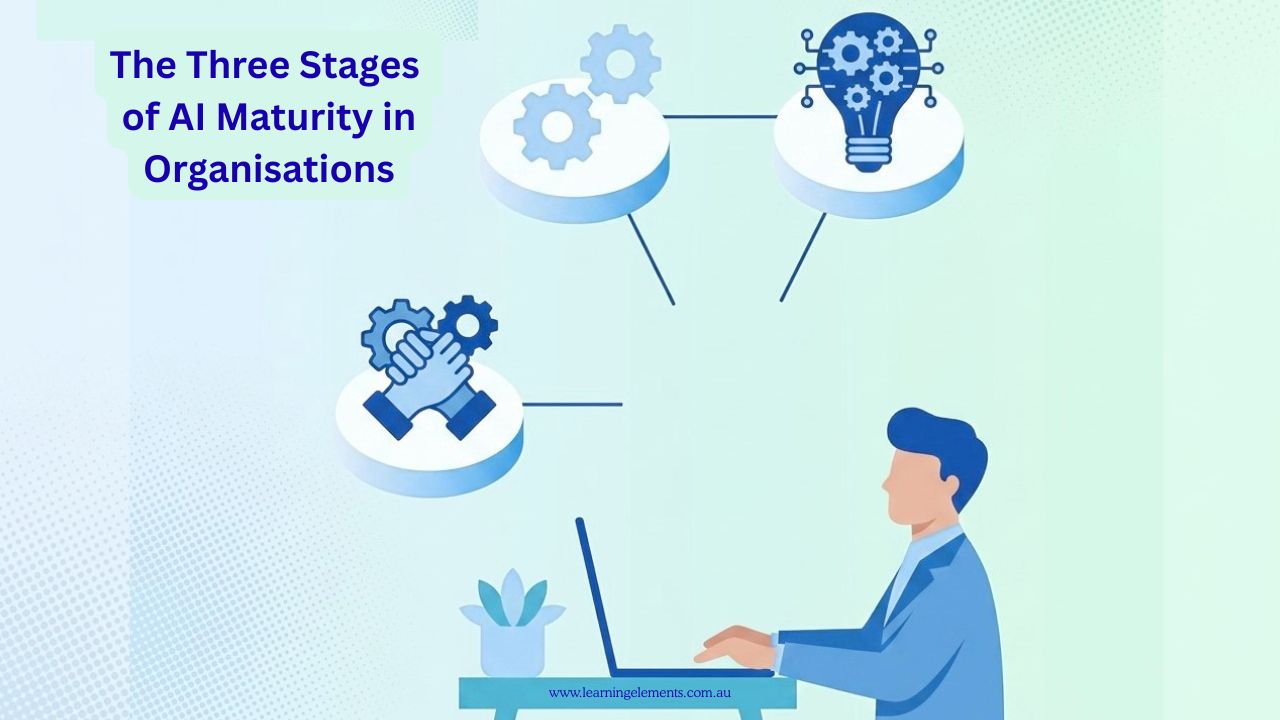
The three stages of AI maturity in organisations are Augment, Assist and Automate, and Agentify and Rework. They describe how organisations can progress from early AI experimentation to structured workflow integration, automation and broader business transformation.
Understanding the three stages of AI maturity in organisations can help HR and Learning and Development leaders assess current AI capability, identify workforce skills gaps and make informed decisions about AI adoption, governance and capability development.
Not every organisation will progress through these stages at the same pace. Different business functions may also sit at different stages at the same time. For example, marketing may already be using AI to automate parts of its workflow while another function is still developing basic AI literacy.
The objective is not to move through the stages as quickly as possible. Sustainable AI adoption requires organisations to establish the right workforce capability, leadership support, governance and operating practices before moving towards more advanced applications.
For Australian HR and L&D professionals, the three stages of AI maturity in organisations provide a practical framework for assessing AI readiness, identifying capability gaps and developing learning strategies that support responsible, sustainable and measurable AI adoption.
In this framework, the three stages describe increasing levels of AI adoption, integration and organisational change.
Why AI Maturity Matters for Organisations
Many organisations approach AI adoption without a clear framework for assessing where they currently stand or what they need to develop before progressing. This often leads to unrealistic expectations, inconsistent adoption and capability gaps that undermine the value of technology investment.
Understanding AI maturity matters because it:
- Aligns technology strategy with actual workforce capability
- Helps leaders set realistic expectations for adoption timelines
- Identifies the specific skills, behaviours and governance practices needed at each stage
- Supports sustainable transformation rather than rushed implementation
- Provides a common language for discussing AI readiness across business functions
- Enables more targeted investment in learning and capability development
Without a maturity framework, organisations risk investing in advanced AI capabilities before their workforce has the foundational skills and confidence to use them effectively. The result is low adoption, wasted investment and growing frustration among employees and leaders alike.
The three stages of AI maturity in organisations provide a structured approach that helps leaders assess current capability honestly, plan development priorities clearly and build the conditions for long-term AI success.
Stage 1: Augment
Characteristics of the Augment Stage
At the Augment stage, organisations are beginning to explore AI. Employees may be using common AI tools such as generative AI assistants, AI-powered productivity software or automated scheduling and communication tools, but adoption is typically inconsistent and largely driven by individual initiative rather than organisational strategy.
Experimentation is limited and often informal. Employees who are curious about AI may explore tools independently, while others remain unaware of the available options or hesitant to engage. Workflow integration is minimal and AI use tends to be disconnected from broader business objectives.
Organisations at this stage have usually not yet established governance frameworks, formal capability development programmes or clear expectations about how AI should be used responsibly within the workplace.
Primary Goals at the Augment Stage
The primary goals at this stage focus on building awareness, establishing foundational understanding and creating the conditions for confident and responsible AI use.
Key goals include:
- Building employee awareness of AI and its workplace relevance
- Developing foundational AI literacy across the workforce
- Improving employee confidence in exploring and using AI tools
- Establishing basic governance and acceptable use guidelines
- Creating a culture of curiosity and responsible experimentation
- Identifying early adopters who can support broader capability building
At the Augment stage, success is not measured by productivity gains or workflow transformation. It is measured by whether employees are developing the foundational understanding and confidence needed to progress to more integrated AI use.
Common Challenges at the Augment Stage
Organisations at the Augment stage typically encounter several common barriers that slow adoption and limit the effectiveness of early AI initiatives.
- Inconsistent Adoption: Without clear organisational direction, AI adoption tends to cluster around enthusiastic individuals while the majority of employees remain disengaged. This creates uneven capability across teams and makes it difficult to build shared understanding or consistent practices.
- Limited Understanding of AI Capabilities and Limitations: Employees at this stage often hold inaccurate perceptions of what AI can and cannot do. Some overestimate AI capabilities and accept outputs uncritically, while others underestimate its value and avoid engagement altogether. Both extremes create risks.
- Employee Scepticism and Uncertainty: Concerns about job displacement, data privacy and the reliability of AI outputs are common at this stage. Without transparent communication and clear governance, scepticism can harden into resistance that becomes increasingly difficult to address as adoption expands.
- Lack of Governance and Guidance: Many organisations at the Augment stage have not yet established clear policies about which AI tools are approved, how data should be handled or what standards apply to AI-generated outputs. This creates compliance risk and reduces employee confidence.
Leadership Priorities at the Augment Stage
- Clear and Transparent Communication: Leaders should communicate why AI is being introduced, what the organisation’s expectations are and how employees will be supported through the transition. Honest communication about both the opportunities and limitations of AI reduces uncertainty and builds trust.
- Establishing Basic Governance: Even at the earliest stage of AI adoption, organisations need clear guidelines about approved tools, data privacy requirements, security expectations and responsible AI use. Basic governance frameworks protect the organisation while providing employees with the clarity they need to engage confidently.
- Encouraging Responsible Experimentation: Leaders should create space for employees to explore AI tools in low-risk environments. Encouraging experimentation without penalising mistakes helps build confidence and generates early insights about which applications are most relevant to the organisation’s work.
Stage 2: Assist and Automate
Characteristics of the Assist and Automate Stage
At the Assist and Automate stage, AI moves from informal experimentation into structured workflow integration. Employees are using AI tools regularly to support specific tasks and business functions, and organisations are beginning to measure potential productivity gains from targeted AI applications.
AI is becoming embedded in function-specific workflows across areas such as HR, marketing, finance, customer service and operations. Rather than individual experimentation, AI use is becoming part of how teams work, with clearer expectations, more consistent practices and stronger alignment between AI applications and business objectives.
Organisations at this stage are also beginning to automate repetitive administrative processes, freeing employees to focus on higher-value work that requires judgement, creativity and relationship management.
Primary Goals at the Assist and Automate Stage
The primary goals at this stage shift from awareness and confidence building toward measurable performance improvement and capability deepening.
Key goals include:
- Improving operational efficiency through targeted AI integration
- Supporting better and faster decision-making with AI-assisted analysis
- Automating repetitive tasks to reduce administrative burden
- Developing role-specific AI skills across business functions
- Building consistent practices and shared standards for AI use
- Connecting AI adoption to measurable business performance outcomes
Common Challenges at the Assist and Automate Stage
- Scaling Adoption Across the Organisation: Moving from individual or team-level AI use to consistent organisation-wide adoption requires significant change management. Without structured capability development and ongoing leadership support, adoption often stalls at departmental level.
- Addressing Skills Gaps: As AI applications become more sophisticated, employees need deeper skills to use them effectively. Basic AI literacy is no longer sufficient. Employees require role-specific applied skills, stronger critical thinking and the ability to evaluate AI outputs in complex business situations.
- Managing Change Resistance: As AI becomes more embedded in workflows, employees who were initially sceptical may become more resistant, particularly if they feel their roles are changing faster than they can adapt. Ongoing communication, practical support and visible leadership engagement are essential for managing this resistance effectively.
- Maintaining Quality and Governance: As AI use expands, the risk of inconsistent quality, governance gaps and privacy breaches increases. Organisations need stronger oversight frameworks, clearer accountability structures and regular auditing of AI applications to ensure standards are maintained.
Leadership Priorities at the Assist and Automate Stage
- Cross-Functional Collaboration: AI adoption at this stage benefits from collaboration across business functions. Leaders should create opportunities for teams to share insights, successful practices and lessons learned, reducing duplication of effort and accelerating organisation-wide capability development.
- Structured Capability Development: Rather than relying on informal learning, organisations at this stage need structured programmes that develop role-specific AI skills, deepen applied capability and build the critical thinking required to use AI effectively in complex situations.
- Performance Measurement: Leaders should establish clear metrics for evaluating the impact of AI adoption on productivity, quality, efficiency and employee capability. Regular measurement helps determine whether AI investments are delivering value and provides the evidence needed to support continued development.
Assess Your Organisation’s AI Maturity
Understanding where your organisation sits across the three stages of AI maturity in organisations is an important step towards building a more effective AI adoption strategy. Learning Elements works with Australian organisations to assess AI readiness and design capability development programmes that align with current maturity and future objectives.
Discuss Your AI Readiness Assessment
Stage 3: Agentify and Rework
Characteristics of the Agentify and Rework Stage
At the Agentify and Rework stage, organisations move beyond using AI to support existing processes and begin redesigning how work is fundamentally structured and delivered. This is the most advanced stage of AI maturity and represents a significant shift in how organisations think about roles, workflows and business models.
Agentic AI systems, which can plan tasks, use tools and systems, and perform multi-step actions with varying levels of human oversight, are beginning to take on more significant roles within business processes. Unlike standard chatbots that typically respond to prompts one turn at a time, agentic AI can create plans, use external tools and APIs, perform multi-step tasks and respond to errors within defined workflows. This can allow AI to move beyond assisting employees with individual tasks and, depending on how the system is designed and governed, manage workflows, make decisions within defined parameters and interact with other systems with limited human oversight.
Process redesign becomes a central activity. Organisations examine which tasks, roles and workflows can be transformed through AI integration, which human capabilities remain essential and how new operating models can deliver greater value for customers, employees and stakeholders.
Primary Goals at the Agentify and Rework Stage
The primary goals at this stage extend beyond efficiency and productivity to encompass business transformation, innovation and the development of new organisational capabilities.
Key goals include:
- Redesigning core business processes to take full advantage of advanced AI capabilities
- Developing new operating models that integrate human and AI capabilities effectively
- Driving innovation through AI-enabled experimentation and new service delivery approaches
- Building the workforce capability needed to manage, oversee and continuously improve agentic systems
- Establishing robust governance frameworks for advanced AI applications
- Building organisational capability to adapt as AI capabilities advance
Common Challenges at the Agentify and Rework Stage
- Governance and Accountability: As AI systems take on more autonomous roles, governance becomes significantly more complex. Organisations must establish clear accountability frameworks that define who is responsible for AI decisions, how errors are identified and corrected, and how compliance with regulatory requirements is maintained.
- Ethical Considerations: Advanced AI integration raises important ethical questions about fairness, transparency, privacy, discrimination and the distribution of work between humans and AI systems. Organisations at this stage must develop robust ethical frameworks and ensure that AI applications reflect the organisation’s values and obligations to employees, customers and the broader community.
- Organisational Complexity: Redesigning workflows and operating models at scale creates significant organisational complexity. Change management, stakeholder alignment, capability development and technology implementation must all be managed simultaneously, requiring strong leadership, clear communication and sustained organisational commitment.
- Workforce Transition: As roles and workflows change significantly, some employees will need to develop substantially new skills or transition into different functions. Managing this transition with care, transparency and adequate support is essential for maintaining employee trust and organisational performance during transformation.
Leadership Priorities at the Agentify and Rework Stage
- Strategic Vision and Direction: Leaders at this stage must articulate a clear and compelling vision for how AI transformation serves the organisation’s long-term objectives. Without strategic clarity, process redesign efforts risk becoming disconnected from business priorities.
- Risk Management and Ethical Oversight: Advanced AI integration requires strong risk management frameworks that address governance, compliance, ethical standards and accountability. Leaders must ensure that AI applications are regularly reviewed, that risks are proactively identified and that the organisation maintains appropriate human oversight of autonomous systems.
- Workforce Transformation: Leaders must invest in helping employees develop the capabilities needed to work effectively alongside advanced AI systems. This includes not only technical and applied skills but also adaptive capabilities such as critical thinking, ethical judgement, learning agility and collaboration. These capabilities enable employees to contribute meaningfully in transformed roles.

The Role of Leadership Across All Three Stages
Effective leadership is an important factor in successful AI adoption across all three stages of AI maturity in organisations. While the specific priorities evolve as organisations progress, several leadership responsibilities remain constant throughout the journey.
- Building Trust: Employees need to trust that AI adoption is being managed with their interests in mind. Leaders who communicate openly, acknowledge uncertainty and demonstrate genuine care for employee wellbeing can create the conditions for sustainable adoption rather than reluctant compliance.
- Supporting Continuous Learning: AI technologies continue to evolve at pace. Leaders who model curiosity, invest in ongoing capability development and create time for employees to learn and experiment send a clear signal that AI fluency is an organisational priority rather than an individual responsibility.
- Creating Alignment: Effective AI adoption requires alignment between technology strategy, workforce capability, governance frameworks and business objectives. Leaders play an important role in creating and maintaining this alignment across functions and throughout each stage of maturity.
- Maintaining Ethical Standards: Across all three stages, leaders must ensure that AI is used in ways that reflect the organisation’s values, meet regulatory requirements, and treat employees, customers and stakeholders with respect and fairness. Ethical leadership is not a priority limited to a specific stage. It is a constant responsibility.
Build the Capability Your Organisation Needs to Progress
Moving through the three stages of AI maturity in organisations requires more than technology investment. It requires structured capability development, leadership alignment and a learning strategy that evolves as your organisation grows. Learning Elements helps Australian organisations assess their current AI maturity and build the workforce capability needed to progress with confidence.
Talk to Learning Elements About AI Capability Development
Assessing Your Organisation’s Current AI Maturity Stage
Knowing which stage of AI maturity your organisation currently occupies can help you make informed decisions about capability development, technology investment and AI adoption strategy.
Key assessment questions to consider include:
Awareness and Adoption
- Are employees aware of AI tools relevant to their roles?
- Is AI use consistent across the organisation or limited to specific individuals or teams?
- Do employees understand the organisation’s expectations about responsible AI use?
Capability and Confidence
- Do employees have the foundational skills needed to use AI tools effectively?
- Are role-specific AI applications being used consistently across business functions?
- Do leaders have sufficient understanding of AI to guide adoption and governance?
Governance and Oversight
- Does the organisation have clear policies about approved AI tools and data privacy?
- Are accountability frameworks in place for AI-generated outputs and decisions?
- Is compliance with relevant Australian regulatory requirements being maintained?
Integration and Impact
- Is AI embedded in core workflows or limited to isolated applications?
- Are measurable productivity or performance improvements being achieved?
- Is the organisation beginning to explore process redesign or advanced AI integration?
The answers to these questions will help identify which stage your organisation currently occupies and what development priorities should be addressed before attempting to progress further.
Moving From One Stage to the Next
Progression through the three stages of AI maturity in organisations is not automatic. It requires deliberate investment in capability development, governance strengthening and cultural change.
Building Foundational Capability Before Advancing
Organisations that attempt to move to more advanced AI integration before establishing solid foundational capability risk creating significant adoption problems. Employees who lack confidence, understanding or practical skills will struggle to use advanced AI applications effectively, regardless of the quality of the technology itself.
Strengthening Leadership at Every Stage
Leadership capability must develop alongside workforce capability. Leaders who are unable to articulate a clear AI vision, model responsible AI use or create the conditions for learning will limit their organisation’s ability to progress, regardless of the technology investments being made.
Developing Adaptive Skills for Long-Term Resilience
As organisations move through the stages of AI maturity, the importance of adaptive skills, including critical thinking, learning agility, ethical judgement and problem-solving, increases significantly. These capabilities enable employees to continue developing as AI technologies evolve, rather than becoming dependent on specific tools or static skill sets.
Creating Continuous Learning Systems
Sustainable AI maturity requires ongoing learning rather than episodic training. Organisations that build continuous learning systems, including regular capability assessments, structured development programmes, workplace application opportunities and leadership reinforcement, are better positioned to advance through maturity stages while maintaining performance and governance standards.
Conclusion
No organisation moves through these stages without challenge. The three stages of AI maturity in organisations provide a practical framework for understanding where an organisation currently stands, what capabilities need to be developed and how to plan for sustainable progression.
No organisation moves through these stages without challenge. Inconsistent adoption, skills gaps, governance complexity and workforce resistance are common at every level. What distinguishes organisations that progress successfully is not the sophistication of their technology but the strength of their leadership, the depth of their workforce capability and their commitment to building an organisational culture where AI is used responsibly, confidently and in ways that deliver genuine business value.
For Australian HR and L&D professionals, the three stages of AI maturity in organisations offer a valuable lens for assessing current capability, designing targeted learning strategies and making the case for sustained investment in workforce development. Long-term success in AI adoption depends on organisational adaptability, not technology alone.
Speak with Learning Elements About Your AI Maturity Journey
Understanding your organisation’s current stage of AI maturity is the foundation for building a more effective adoption strategy. Learning Elements works with Australian HR and L&D leaders to assess AI readiness, develop leadership capability and design workforce learning programmes that support sustainable transformation at every stage.
Book an AI Maturity Consultation