
AI fluency is the ability to understand, apply and work alongside artificial intelligence with confidence, judgement and purpose. It is rapidly becoming a core business capability rather than a specialist technical skill.

Many Australian organisations still approach AI as a technology initiative. They invest in software, introduce new tools and provide basic training on how those tools work. But technology alone does not create business value. Real value comes from people who understand when AI should be used, where it can improve performance, and how to apply it responsibly within their roles.

For HR and Learning & Development professionals, this represents a significant workforce capability challenge. The organisations that will benefit most from AI are unlikely to be those with the largest technology budgets. They will be those that build AI fluency across their workforce, creating a culture where people use AI with confidence, responsibility and genuine business impact.

What Is AI Fluency?

As AI becomes part of everyday work, terms such as AI literacy, AI skills, and AI fluency are often used interchangeably. While they are closely related, they describe different stages of workforce capability. Understanding these differences helps organisations design more effective learning strategies and set realistic expectations for AI adoption.

For Australian HR and L&D professionals, developing AI fluency across the workforce represents a practical response to the growing pressure to demonstrate measurable capability outcomes from AI investment.

AI Literacy

AI literacy provides the foundation. It refers to an individual’s basic understanding of artificial intelligence, including what AI is, how it works at a high level, and where it is commonly used.

Employees with AI literacy can generally:

  • Recognise common AI technologies
  • Understand basic AI terminology
  • Identify potential workplace applications
  • Appreciate both the benefits and limitations of AI

However, literacy alone does not necessarily enable employees to apply AI confidently in their day-to-day work.

AI Skills

AI skills focus on practical capability, referring to the specific technical or operational abilities employees need to use AI tools effectively within their roles.

Examples include:

  • Writing effective prompts for generative AI
  • Using AI-assisted productivity software
  • Automating repetitive administrative tasks
  • Analysing data using AI-powered tools
  • Creating content with AI while maintaining quality standards

These practical skills are essential, but they often relate to particular platforms or technologies that may change over time.

AI Fluency

AI fluency goes beyond understanding concepts or learning individual tools. It refers to an employee’s ability to use AI confidently, critically, and responsibly to improve workplace performance.

Someone who is AI fluent understands not only how to use AI, but also:

  • When AI is the appropriate solution
  • Where human judgement remains essential
  • How to assess AI-generated outputs critically
  • The ethical and governance considerations involved
  • How AI supports broader business objectives

Rather than relying on rigid instructions, AI-fluent employees can adapt their knowledge to different situations and continue learning as technologies evolve.

This distinction is becoming increasingly important as organisations seek long-term workforce capability rather than short-term technical proficiency.

Why AI Fluency Extends Beyond Technical Teams

One of the biggest misconceptions surrounding AI is that it only matters for technical specialists.

In reality, AI now influences almost every business function. Marketing teams use AI to accelerate content development. Human Resources teams use AI to support recruitment and workforce planning. Finance teams use AI to improve forecasting and reporting. Customer service teams rely on AI to respond more efficiently while maintaining service quality.

Even executives who never directly interact with AI software need enough understanding to evaluate opportunities, assess risks, make investment decisions, and establish appropriate governance.

This widespread impact means AI fluency is no longer confined to IT departments. It has become a business capability that enables employees at every level to contribute more effectively to organisational success.

Developing AI fluency across the workforce also creates a shared understanding of how AI should be used within the organisation. When leaders, managers, and employees share common principles, expectations, and terminology, collaboration becomes easier and AI adoption becomes more consistent.

Instead of viewing AI as a specialist capability owned by a single department, organisations can begin treating it as a core workplace competency that supports continuous improvement, innovation, and informed decision-making across every business function.

Why Technical Skills Alone Are Not Enough

Many organisations begin their AI journey by teaching employees how to use specific tools. While this is an important first step, tool-focused training alone rarely delivers lasting business value.

Technology continues to evolve at an extraordinary pace. AI platforms, features and applications continue to evolve rapidly, making it unrealistic for organisations to rely solely on training employees to use individual tools. A workforce that depends only on technical instructions can quickly fall behind as technologies change.

Instead, organisations need employees who can think critically about how AI supports their work, evaluate its outputs and make informed decisions based on business context. These broader capabilities allow people to adapt as AI evolves rather than constantly relearning new systems from scratch.

For example, a marketing professional using generative AI still needs to assess whether content aligns with brand standards and audience expectations. A manager reviewing AI-generated reports must determine whether recommendations reflect the organisation’s priorities. Likewise, a customer service representative using AI-assisted responses must apply empathy and professional judgement when responding to individual customer needs.

In each of these situations, technical proficiency alone is not enough. Employees also require critical thinking, ethical awareness, communication skills and sound judgement to apply AI effectively.

This shift highlights an important reality: successful AI adoption depends as much on human capability as it does on technology. Organisations that focus exclusively on technical training risk creating employees who know how to operate AI tools but lack the confidence and judgement to use them effectively in real business situations.

Building AI fluency therefore means helping people combine technical knowledge with practical decision-making, adaptability and continuous learning. These capabilities enable employees to respond confidently to changing technologies while maintaining quality, accountability and business performance.

AI Fluency as an Organisational Capability

As AI becomes embedded in everyday business activities, organisations are recognising that individual tool proficiency is no longer sufficient. What is needed is organisational AI fluency, a consistent and shared capability that enables employees at every level to apply AI confidently, responsibly and in ways that support broader business performance.

This shift mirrors previous stages of digital transformation. Technologies such as cloud computing, collaboration platforms, and data analytics were once considered specialist capabilities. Today, they are part of normal business operations. AI is following the same path. As its use expands across organisations, employees at every level need sufficient understanding to apply AI confidently and responsibly within their own roles.

Creating a Shared Language Around AI

One of the biggest challenges organisations face is inconsistency in how employees understand and discuss AI. Different departments may have varying levels of knowledge, use different terminology, or hold unrealistic expectations about what AI can and cannot do.

Creating a shared language helps establish consistency across the organisation. Employees should understand:

  • Common AI concepts and terminology
  • The organisation’s approach to AI adoption
  • Approved and appropriate use cases
  • Privacy, security, and governance expectations
  • The continued importance of human judgement

When everyone shares the same understanding, collaboration improves, confusion is reduced, and AI initiatives become easier to implement across teams.

Building Confidence Across Teams

Confidence is one of the strongest predictors of successful AI adoption. Some employees are eager to use AI but lack practical experience, while others remain hesitant because they are concerned about making mistakes or relying too heavily on new technology.

Building confidence requires more than introducing new tools. Employees need opportunities to practise, receive feedback, ask questions, and see how AI supports their everyday work. Learning should focus on practical application rather than theoretical knowledge alone.

Confidence grows when employees have:

  • Clear guidance and expectations
  • Access to role-specific examples
  • Opportunities to experiment safely
  • Ongoing coaching and support
  • Time to apply new skills in real work situations

As confidence increases, employees are more likely to adopt AI consistently and identify new opportunities to improve productivity and business performance.

Aligning AI Use with Business Objectives

AI initiatives deliver the greatest value when they support clearly defined business objectives rather than simply introducing new technology.

Organisations should help employees understand how AI contributes to priorities such as:

  • Improving operational efficiency
  • Supporting better decision-making
  • Reducing repetitive administrative work
  • Enhancing customer experiences
  • Driving innovation
  • Increasing productivity

When AI learning is connected to measurable business outcomes, employees gain a clearer understanding of why capability development matters. This alignment also helps leaders prioritise investments, measure success, and ensure AI adoption supports the organisation’s long-term strategy rather than becoming another standalone technology project.

Aligning AI Fluency and Use with Business Objectives

Build AI Capability Across Your Organisation

Many organisations invest in AI technology but struggle to build lasting workforce capability. Developing AI fluency requires practical learning experiences, leadership support, and a strategy that aligns capability development with business objectives.

Learning Elements works with Australian organisations to design practical AI capability programmes that align with business objectives and prepare leaders, managers and employees to use AI with confidence.

Discuss AI Capability Development

The Role of Leaders in Building AI Fluency

Leaders have a significant influence on how AI is perceived and adopted throughout an organisation. Employees often look to leadership for direction, reassurance, and practical guidance when new technologies are introduced. If leaders actively support AI capability development, employees are far more likely to engage with learning and apply AI confidently in their daily work.

Building AI fluency therefore starts with leadership. While senior leaders do not need to become technical experts, they do need enough understanding to make informed decisions, guide organisational priorities, and create an environment where responsible AI use becomes part of everyday business practice.

Setting Expectations and Direction

Successful AI adoption begins with a clear vision.

Leaders should communicate why AI is being introduced, what business challenges it aims to solve, and how employees are expected to use it. Clear expectations reduce uncertainty and help teams understand that AI supports business performance rather than replacing human expertise.

Employees should understand:

  • Why AI matters to the organisation
  • How AI aligns with business strategy
  • Where AI should and should not be used
  • What success looks like
  • How responsible AI use will be supported

Clear direction creates consistency and encourages greater confidence across the workforce.

Leading by Example

Employees are more likely to adopt new behaviours when they see leaders demonstrating them.

Leaders who openly use AI, discuss both opportunities and limitations, and participate in learning activities reinforce that AI capability is an organisational priority rather than a technical initiative confined to IT teams.

Leading by example may involve:

  • Using AI to support planning and decision-making
  • Sharing lessons learned from experimentation
  • Encouraging discussion about responsible AI use
  • Demonstrating curiosity and continuous learning
  • Supporting evidence-based decision-making

These behaviours help build trust and encourage employees to approach AI with confidence rather than hesitation.

Creating Opportunities for Experimentation

Employees rarely develop confidence through demonstrations alone. Practical experience is essential.

Leaders can encourage responsible experimentation by creating opportunities for teams to test AI in controlled environments before wider implementation. Small pilot projects allow employees to explore different use cases, identify productivity improvements, and build confidence without creating unnecessary business risk.

Supporting experimentation may include:

  • Team-based pilot programmes
  • Internal AI communities
  • Practical workshops
  • Cross-functional knowledge sharing
  • Recognition of successful AI initiatives

Learning through practical experience helps employees build capability much faster than relying solely on formal training.

Addressing Uncertainty and Resistance

Some resistance to AI is inevitable, particularly when employees are unsure how new technologies will affect their work.

Leaders should encourage open conversations, answer questions honestly, and acknowledge legitimate concerns. Transparent communication helps reduce uncertainty and reinforces that AI is intended to support employees rather than replace them.

Providing ongoing learning opportunities, practical guidance, and clear governance enables employees to build confidence while reducing fear associated with organisational change.

When leaders address resistance thoughtfully and consistently, they create the conditions for AI fluency to grow across the organisation rather than remain confined to early adopters.

Common Barriers to AI Fluency

Understanding what prevents AI fluency from taking hold is just as important as knowing how to build it. Although interest in AI continues to grow rapidly, many organisations still encounter challenges when trying to build AI capability across their workforce. Recognising these barriers early allows leaders to develop more effective learning strategies and improve adoption outcomes.

Fear of Job Displacement

One of the most common concerns is that AI will replace human jobs.

While AI is changing how work is performed, most organisations continue to rely on employees to provide judgement, creativity, collaboration, relationship management, and ethical decision-making. AI should be positioned as a tool that enhances human capability rather than replaces it.

Helping employees understand this distinction reduces anxiety and encourages greater engagement with learning.

Lack of Practical Application

Many organisations introduce AI through presentations or demonstrations but provide limited opportunities for employees to apply what they have learned.

Without immediate workplace application, knowledge fades quickly and confidence declines. Learning should therefore focus on practical scenarios that allow employees to integrate AI into their existing workflows and responsibilities.

Limited Leadership Engagement

Employees are less likely to embrace AI if leaders show little interest or involvement.

Visible leadership participation demonstrates organisational commitment and reinforces that AI capability is a strategic priority rather than a temporary initiative.

Insufficient Governance and Guidance

Employees need clear guidance regarding:

  • Approved AI tools
  • Data privacy requirements
  • Security expectations
  • Responsible AI use
  • Human oversight and accountability

Without clear governance, employees may avoid AI altogether or use it inconsistently, increasing organisational risk and reducing the benefits of adoption.

AI fluency depends not only on knowledge but also on confidence that employees are using AI within appropriate organisational guidelines.

Treating AI Fluency as a One-Off Training Event

One of the biggest barriers is assuming that a single workshop or online course is enough.

AI technologies continue to evolve rapidly, and workforce capability must evolve alongside them. Organisations that achieve long-term success treat AI fluency as an ongoing learning journey supported by continuous development, workplace application, leadership reinforcement, and regular capability building.

By addressing these barriers proactively, organisations can create an environment where employees continue developing their AI capability while supporting innovation, productivity, and sustainable business growth.

Building AI Fluency Across the Organisation

Developing AI fluency is not about delivering a single training course or expecting employees to become experts overnight. It requires a structured capability-building approach that supports employees as AI technologies evolve and become increasingly integrated into everyday work.

Successful organisations recognise that AI fluency develops progressively. Employees first need a solid understanding of AI concepts before learning how to apply AI within their specific roles. Over time, they also develop the adaptability needed to evaluate new technologies, solve unfamiliar problems, and continue learning as AI capabilities advance.

A practical AI capability framework typically focuses on three areas: foundational skills, applied skills, and adaptive skills. Together, these capabilities help employees use AI confidently, responsibly, and effectively while supporting broader organisational objectives.

Foundational Skills

Foundational skills provide employees with the basic understanding needed to work confidently with AI. Without this foundation, employees may struggle to understand AI outputs, identify appropriate use cases, or recognise potential risks.

Rather than focusing on technical complexity, foundational learning should help employees understand how AI fits into their everyday work and the organisation’s broader strategy.

Key areas include:

  • Understanding AI concepts and terminology
  • Recognising common workplace AI applications
  • Writing effective prompts for generative AI tools
  • Evaluating AI-generated content critically
  • Understanding privacy, security, and governance requirements
  • Applying ethical principles when using AI

Foundational learning should also clarify what AI cannot do. Employees who understand the limitations of AI are better equipped to question inaccurate outputs, identify bias, and apply human judgement where required.

When employees share a common understanding of AI fundamentals, organisations are better positioned to implement AI consistently and responsibly across every business function.

Applied Skills

Once employees understand the fundamentals, they need opportunities to apply AI in ways that directly support their roles.

Applied learning focuses on solving real business problems rather than simply demonstrating software features. Employees develop confidence much faster when learning is connected to tasks they already perform.

Examples include:

  • Drafting reports and presentations
  • Summarising lengthy documents
  • Supporting customer enquiries
  • Creating marketing content
  • Conducting research
  • Analysing operational data
  • Automating repetitive administrative activities
  • Improving project planning

Because different departments have different priorities, learning should be tailored to specific functions wherever possible.

For example:

  • HR teams may focus on recruitment, policy development, and workforce planning.
  • Marketing teams may use AI for content planning, campaign analysis, and customer insights.
  • Finance teams may use AI to improve reporting and forecasting.
  • Customer service teams may apply AI to support faster response times while maintaining service quality.

Role-specific learning increases relevance, improves engagement, and accelerates adoption because employees can immediately see how AI benefits their daily work.

Adaptive Skills

While technical knowledge and practical application are important, adaptive skills often determine whether organisations continue benefiting from AI over the long term.

Technology will continue changing. Employees therefore need the ability to learn continuously rather than rely solely on existing knowledge.

Adaptive skills include:

  • Critical thinking
  • Decision-making
  • Learning agility
  • Curiosity
  • Problem-solving
  • Communication
  • Collaboration
  • Ethical judgement

These capabilities help employees evaluate AI recommendations rather than accepting them automatically. They also enable teams to identify new opportunities, adapt to changing technologies, and continuously improve business processes.

Employees who possess strong adaptive skills are generally more comfortable experimenting with new approaches while maintaining appropriate governance and accountability.

Ultimately, AI fluency is not about replacing human capability. It is about strengthening the uniquely human skills that allow employees to work effectively alongside AI.

Turn AI Learning Into Everyday Performance

Building AI fluency requires more than introducing new technology. Organisations achieve stronger outcomes when learning becomes part of everyday work rather than an occasional training event.

Learning Elements helps organisations design practical capability-building programmes that integrate AI learning into existing workflows, enabling employees to develop confidence while continuing to deliver business results.

Create an AI Learning Strategy

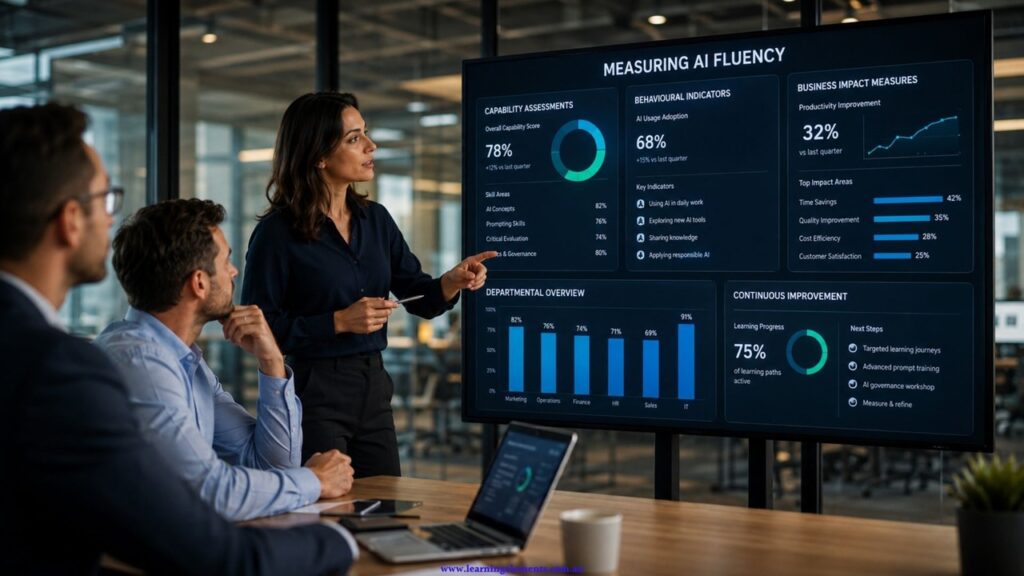
Measuring AI Fluency and Business Capability of Organisations

Measuring AI Fluency

Building AI fluency is an ongoing process rather than a one-time achievement. Measuring progress helps organisations understand whether capability-building initiatives are translating into meaningful workplace outcomes rather than simply increasing training participation.

Traditional learning metrics such as attendance records or course completion rates provide useful information, but they offer only a partial picture. Organisations should also evaluate how employees apply AI within their roles, whether confidence is increasing, and how AI contributes to broader business objectives.

Capability Assessments

Capability assessments provide insight into employees’ current level of AI understanding and identify areas requiring further development.

Assessments may include:

  • Knowledge checks
  • Practical workplace scenarios
  • AI use case evaluations
  • Manager observations
  • Self-assessments

These assessments should focus on employees’ ability to apply AI responsibly rather than simply recalling information.

Behavioural Indicators

Behavioural change often provides one of the strongest indicators of successful AI capability development.

Organisations may observe whether employees are:

  • Using approved AI tools appropriately
  • Applying AI to improve workflows
  • Sharing successful practices with colleagues
  • Asking more informed questions
  • Demonstrating greater confidence when working with AI

Monitoring these behaviours helps organisations understand whether learning is translating into everyday performance.

Business Impact Measures

Ultimately, AI fluency should contribute to measurable business outcomes.

Examples include:

  • Improved productivity
  • Faster decision-making
  • Reduced administrative workload
  • Higher quality outputs
  • Improved customer experience
  • Greater innovation
  • Increased employee engagement

By connecting capability development with operational performance, organisations can better demonstrate the value of AI learning initiatives.

Continuous Improvement

AI capability is never complete. As technologies continue to evolve, organisations should regularly review learning programmes, gather employee feedback, evaluate emerging AI tools, and update capability frameworks accordingly.

Continuous improvement ensures AI fluency remains aligned with changing business priorities while helping employees continue developing their knowledge and confidence over time.

How Learning Elements Can Help

At Learning Elements, we help organisations build practical AI capability through leadership development, workplace learning, instructional design, and organisational capability programmes that align with real business objectives.

Rather than focusing solely on AI tools, we help leaders, managers, and employees develop the confidence, judgement, and practical skills needed to apply AI effectively within their everyday work.

Our capability-building approach combines learning strategy, change management, workplace application, and ongoing development to support sustainable AI adoption while maintaining operational performance.

Whether your organisation is beginning its AI journey or looking to strengthen existing capability, Learning Elements can help develop an AI-ready workforce equipped for long-term success.

Conclusion

AI is rapidly changing the way organisations operate, collaborate, and make decisions. While new technologies continue to attract significant attention, sustainable business value depends far less on the tools themselves and far more on the people using them.

This is why AI fluency is becoming a core business capability rather than simply a technical skill. Employees across every function increasingly need the confidence, judgement, and practical knowledge to use AI responsibly while continuing to apply critical thinking, ethical decision-making, and professional expertise.

Building AI fluency requires more than isolated training sessions or demonstrations of new software. It depends on leadership commitment, practical workplace learning, clear governance, and continuous capability development that enables employees to adapt as AI continues to evolve.

Organisations that invest in AI fluency today are creating more resilient workforces that can respond confidently to future technological change. Rather than simply keeping pace with AI, they are building the capability to use it strategically, responsibly, and in ways that deliver measurable business outcomes.

As AI becomes part of everyday work, organisations that treat AI fluency as an organisational capability will be better positioned to improve productivity, strengthen decision-making, support innovation, and remain competitive in an increasingly AI-enabled business environment.

Prepare Your Workforce for an AI-Enabled Future

AI fluency is no longer limited to technical specialists. It is becoming a core capability that supports better decision-making, stronger collaboration, and improved organisational performance.

Learning Elements partners with organisations to develop AI-ready leaders, teams, and workplace capability through practical learning solutions tailored to your business objectives.

Book an AI Capability Consultation