
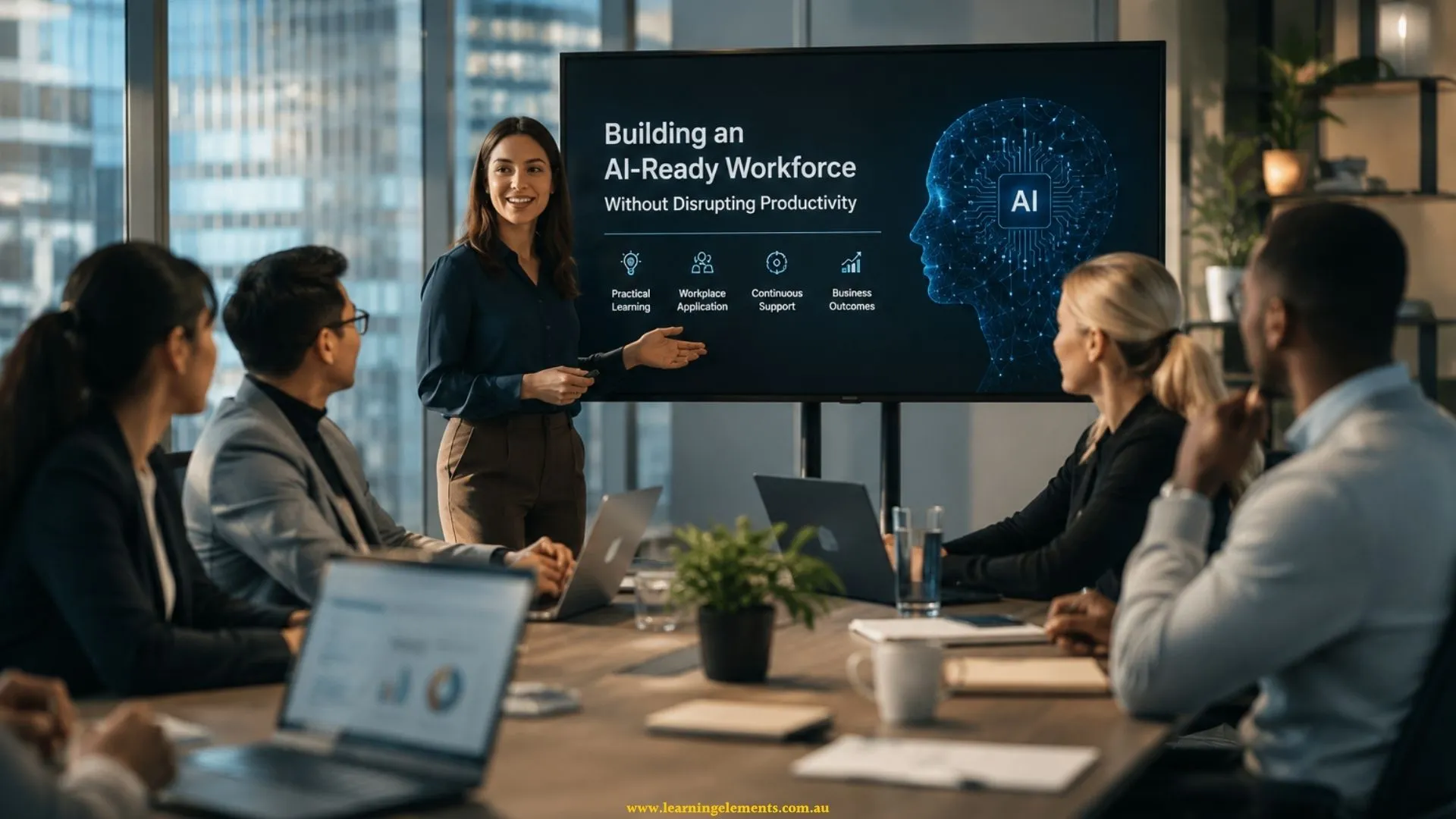
Building an AI-ready workforce without disrupting productivity has become one of the biggest challenges facing organisations today.
Across Australia and globally, organisations are investing heavily in AI technologies to improve efficiency, support decision-making, and strengthen competitiveness. However, many leaders face a common challenge: how to build workforce capability without affecting operational performance.
As organisations adopt new AI tools and processes, employees must develop the skills and confidence to use them effectively. The challenge is finding ways to support learning while maintaining productivity and meeting business objectives.
The reality is that many traditional training approaches are not designed for today’s workplace. Long classroom sessions, isolated workshops, and one-off learning events often remove employees from their work without creating lasting behavioural change.
Successful organisations understand that AI readiness is not simply about teaching people how to use new tools. It is about helping employees integrate new ways of working into their daily routines while maintaining performance and achieving business goals.
According to research from the World Economic Forum, organisations that invest in workforce capability development are better positioned to respond to technological change and future skill requirements.
The key challenge is clear: how can organisations build AI capability while keeping productivity levels high? The answer lies in creating learning experiences that support work rather than interrupt it.
Understanding the Productivity Concern
Before organisations can successfully build an AI-ready workforce, they must understand why productivity concerns arise in the first place.
Time Away from Work
One of the most common concerns is the amount of time employees spend away from their core responsibilities.
Traditional training programmes often require employees to attend full-day workshops, lengthy webinars, or structured courses. While these activities may provide useful information, they can also create operational disruptions.
Managers may worry about:
- Delayed project deadlines
- Reduced customer responsiveness
- Lower output during training periods
- Increased pressure on remaining team members
When training is perceived as competing with work rather than supporting it, resistance often increases.
Information Overload
Many AI initiatives attempt to teach employees everything at once.
Workers are introduced to multiple tools, technical concepts, new processes, governance frameworks, and emerging technologies within a short period. This creates cognitive overload and reduces knowledge retention.
Employees frequently report feeling overwhelmed when:
- Too much information is delivered simultaneously
- Learning content lacks practical relevance
- Training focuses heavily on theory
- There are limited opportunities for application
As a result, productivity can temporarily decline while employees struggle to process and apply new knowledge.
Technology Adoption Fatigue
Many organisations have experienced continuous waves of digital transformation over the past decade.
Employees have already adapted to:
- New collaboration platforms
- Cloud-based systems
- Digital workflows
- Hybrid work environments
- Data management tools
Introducing AI can sometimes feel like another major change initiative. Without proper planning, employees may experience technology adoption fatigue, reducing engagement and slowing implementation.
Resistance to Change
Resistance is often misunderstood.
Employees are not necessarily resistant to AI itself. More commonly, they are uncertain about:
- How AI will affect their roles
- Whether their skills will remain relevant
- What new expectations will emerge
- How success will be measured
Addressing these concerns early is essential for maintaining productivity during workforce transformation.
Why AI Readiness Is About More Than Training
AI readiness is often approached as a training challenge. Organisations identify skills gaps, select learning content, and schedule workshops to prepare employees for new technologies. While training remains important, workforce capability involves much more than knowledge acquisition.
Employees must understand how AI supports their role, where it creates value, and how it aligns with organisational goals. Without this context, even well-designed training programmes can struggle to achieve meaningful adoption.
Successful AI readiness requires more than technical skills. It also depends on leadership support, effective systems, clear expectations, and opportunities for employees to apply new capabilities in their day-to-day work.
Skills Development Versus Capability Building
Skills development focuses on teaching specific tasks. Capability building focuses on enabling employees to apply knowledge effectively in real-world situations.
For example, learning how to write prompts for an AI tool is a skill. Knowing when, why, and how to use AI responsibly to improve business outcomes represents capability.
Capability development includes:
- Critical thinking
- Decision-making
- Problem-solving
- Collaboration
- Adaptability
These broader competencies determine whether AI delivers measurable value.
The Importance of Organisational Systems
Even highly skilled employees struggle if organisational systems do not support new behaviours.
Successful AI readiness programmes address:
| Capability Area | Supporting System |
|---|---|
| Learning | Continuous development opportunities |
| Governance | Clear policies and guidelines |
| Leadership | Visible sponsorship |
| Performance | Relevant success measures |
| Technology | Accessible and user-friendly tools |
Without these supporting structures, learning rarely translates into sustained workplace performance.
Creating Sustainable Change
AI readiness should not be viewed as a short-term project. Technology will continue to evolve rapidly. Organisations must therefore build cultures that support continuous learning and adaptation. Sustainable change occurs when learning becomes part of organisational culture rather than a temporary initiative.
Build AI Capability That Delivers Real Business Results
Many organisations invest in AI tools but struggle to achieve meaningful adoption. Building workforce capability requires more than training sessions. It requires a clear strategy that aligns learning, leadership, and operational goals.
Learning Elements helps organisations design practical capability-building programmes that support AI adoption while maintaining business performance.
Discuss Your AI Workforce Strategy
Common Mistakes Organisations Make
Despite good intentions, many organisations unintentionally create barriers to successful AI adoption.
One-Off Training Events
One-off workshops often generate enthusiasm but fail to create lasting change.
Common problems include:
- Limited follow-up support
- Lack of practical application
- Poor reinforcement
- Declining knowledge retention
Research consistently shows that learning requires reinforcement over time to become embedded into workplace behaviours.
Technology Before Strategy
Many organisations purchase AI tools before defining business objectives.
This approach often leads to:
- Low adoption rates
- Unclear use cases
- Employee confusion
- Limited return on investment
Technology should support organisational goals, not dictate them.
Ignoring Managers
Managers play a critical role in shaping employee behaviour.
When managers are excluded from AI readiness initiatives, employees receive mixed messages about priorities and expectations.
Frontline leaders influence:
- Learning participation
- Behavioural reinforcement
- Team engagement
- Practical application
Without manager involvement, adoption efforts frequently stall.
Measuring Completion Instead of Impact
Many organisations measure:
- Course attendance
- Completion rates
- Assessment scores
While these metrics have value, they do not demonstrate business impact.
A more meaningful approach focuses on:
- Behaviour change
- Performance improvement
- Process efficiency
- Business outcomes
Completion is only the beginning of capability development.
Embedding Learning into Daily Work
The most effective organisations integrate learning directly into everyday activities. Building an AI-ready workforce without disrupting productivity requires learning approaches that support immediate application rather than lengthy periods away from work.
When learning becomes part of daily workflows, employees can develop new skills while continuing to perform their roles effectively. This approach reduces disruption, improves knowledge retention, and increases the likelihood of long-term adoption.
Learning in the Flow of Work
Learning in the flow of work enables employees to develop capability while performing their jobs. Rather than separating learning from work, organisations combine the two. This allows employees to apply new knowledge immediately while remaining productive.
Examples include:
- AI-supported customer service workflows
- Guided prompt libraries
- Embedded knowledge resources
- Workflow-based coaching
Employees learn while completing real tasks, making it easier to transfer new skills into day-to-day performance and achieve lasting behaviour change.
Real-Time Application
Immediate application improves retention and confidence. When employees can use newly acquired knowledge straight away, they are more likely to adopt new behaviours successfully. This approach significantly reduces productivity disruption.
Microlearning and Just-in-Time Support
Microlearning provides targeted information when employees need it most.
Benefits include:
- Reduced time commitment
- Improved engagement
- Higher retention rates
- Greater flexibility
Examples include:
- Five-minute videos
- Quick reference guides
- Interactive job aids
- Short coaching sessions
These resources fit naturally into busy work schedules.
Experimentation and Practice
AI capability develops through practice.
Organisations should create safe environments where employees can:
- Test new tools
- Experiment with workflows
- Share lessons learned
- Build confidence gradually
Small-scale pilots often generate valuable insights while minimising operational risk.
Turn Learning Into Everyday Performance
The most effective AI learning programmes are those that fit naturally into employees’ daily work. Rather than taking people away from their responsibilities, workplace learning should help them apply new skills immediately.
At Learning Elements, we design learning experiences that integrate with existing workflows, helping teams build confidence and capability without disrupting productivity.
Create a Workplace Learning Plan

Building Role-Specific AI Capability
Not every employee needs the same AI skills. Different roles require different levels of knowledge, responsibility, and decision-making capability. Tailoring learning to specific audiences helps ensure employees receive relevant support while improving engagement and adoption.
By aligning AI capability development with job responsibilities, organisations can focus learning efforts where they will have the greatest impact on performance and business outcomes.
Leaders
Senior leaders require an understanding of:
- Strategic opportunities
- Business transformation
- Risk management
- Governance frameworks
- Investment decisions
Their role is not necessarily technical expertise but informed decision-making.
Leaders should understand how AI aligns with organisational objectives and long-term growth plans.
Managers
Managers act as the bridge between strategy and execution.
They need capability in:
- Coaching teams
- Supporting adoption
- Identifying opportunities
- Managing performance
- Addressing concerns
Managers also play a key role in helping employees apply AI effectively within their specific roles.
Individual Contributors
Individual contributors often focus on practical application.
Relevant areas include:
- Workflow improvement
- Productivity enhancement
- Content creation support
- Data analysis assistance
- Task automation
Training should focus on real workplace scenarios rather than generic demonstrations. Providing practical, role-relevant learning opportunities helps employees identify where AI can support their work without creating unnecessary complexity. Role-specific learning increases relevance and improves engagement across the workforce.
Supporting Adoption Through Change Management
Technology adoption succeeds when organisations manage the human side of change effectively. Even the most advanced AI tools can struggle to deliver value if employees do not understand, trust, or adopt them. Effective change management helps create the conditions for sustained behavioural change and long-term success.
Communication Strategies
Clear communication reduces uncertainty.
Employees need to understand:
- Why AI is being introduced
- What benefits it offers
- How it affects their work
- What support is available
Consistent messaging builds trust and confidence.
Employee Involvement
Employees are more likely to support change when they participate in the process.
Effective involvement includes:
- Pilot programmes
- Feedback sessions
- User testing
- Working groups
Participation increases ownership and commitment.
Feedback Loops
Continuous feedback helps organisations refine their approach.
Useful mechanisms include:
- Surveys
- Focus groups
- Manager discussions
- Performance reviews
Feedback provides valuable insights into adoption challenges and opportunities.
Celebrating Early Wins
Visible success stories create momentum.
Examples may include:
- Reduced administrative workload
- Faster reporting processes
- Improved customer response times
- Increased employee satisfaction
Recognising achievements reinforces positive behaviours and encourages broader participation.
Measuring Success
Measuring success requires organisations to look beyond course completion rates and participation numbers. The most valuable measures connect workforce capability development with business outcomes, employee confidence, and operational performance.
Adoption Metrics
Organisations should track:
- Active tool usage
- Frequency of use
- Participation rates
- Capability development progress
These indicators provide visibility into engagement levels.
Business Outcomes
Ultimately, AI adoption should support measurable business results.
Examples include:
- Improved efficiency
- Reduced costs
- Faster processes
- Better customer experiences
- Increased innovation
Business outcomes provide stronger evidence of success than training metrics alone.
Employee Confidence
Confidence often predicts long-term adoption.
Assessment methods may include:
- Self-evaluations
- Manager observations
- Practical demonstrations
- Capability assessments
Higher confidence levels generally support sustained behaviour change.
Productivity Indicators
Because productivity remains a primary concern, organisations should monitor:
- Output levels
- Quality measures
- Cycle times
- Operational performance
Successful AI readiness programmes should maintain or improve productivity rather than reduce it.
Conclusion
Building an AI-ready workforce without disrupting productivity is entirely achievable when organisations adopt the right approach. Rather than relying on isolated training programmes, successful organisations focus on continuous capability development, role-specific learning, workplace application, and effective change management.
AI readiness is not simply about learning new tools. It is about helping employees work more effectively, make better decisions, and adapt confidently to evolving business requirements. When learning is embedded into daily work, supported by managers, and aligned with organisational goals, productivity can be maintained and often improved throughout the transformation process.
The organisations that succeed will be those that view AI readiness as an ongoing capability-building journey rather than a one-time training initiative.
How Learning Elements Can Help
At Learning Elements, we help organisations build workforce capability while maintaining operational performance. Our expertise in leadership development, workplace learning, instructional design, change management, and capability building supports organisations navigating AI-driven transformation.
We work with businesses to design practical learning solutions that fit into everyday work, helping employees develop confidence and capability without unnecessary disruption to productivity.
Whether you are preparing leaders, managers, or frontline teams for AI adoption, Learning Elements can help create a tailored workforce capability strategy aligned with your business objectives.
Prepare Your Workforce for the Future of Work
AI adoption is not simply a technology initiative. It is a workforce capability challenge. Organisations that invest in practical learning, leadership development, and change management are better positioned to achieve long-term success.
Learning Elements works with organisations to build future-ready teams through tailored learning solutions, leadership development programmes, and organisational capability strategies.
Speak With Our Learning Specialists