

By 2026, mastering training reporting best practices has become a competitive necessity for any forward-thinking organisation. The focus has shifted away from mere “tick-the-box” completion rates toward dynamic, real-time insights and capability dashboards that bridge the gap between learning and actual business performance. As AI integration accelerates, these training reporting best practices prioritise measuring tangible behavioural shifts and long-term ROI, ensuring that professional development directly fuels organisational growth.
Organisations are under increasing pressure to demonstrate the tangible value of their learning and development (L&D) initiatives, not only in terms of participation but through measurable outcomes. Modern reporting has evolved far beyond simple attendance tracking and now plays a critical role in revealing workforce capability, identifying skills gaps, and informing strategic decision-making. When designed correctly, training reports provide a clear link between learning activities and organisational performance outcomes.
Building on broader conversations around automated training reports, organisations must now focus on refining how data is structured, analysed, and communicated to stakeholders at all levels.
Why Training Reporting Matters More Than Ever
Corporate learning environments are increasingly complex, often involving multiple platforms, blended delivery models, and diverse learner needs. Without a structured reporting approach, valuable data becomes fragmented and underutilised.
Effective training reporting best practices ensure that learning data is:
- Meaningful and aligned with business goals
- Accessible to relevant stakeholders
- Actionable for continuous improvement
- Scalable as organisational needs grow
In essence, reporting transforms learning from a cost centre into a performance driver.
Core Benefits of Strong Reporting Practices
Implementing well-defined training reporting best practices delivers several important organisational advantages, ensuring that learning and development (L&D) is viewed as a value driver rather than a cost centre.
1. Clear Visibility of Workforce Capability
Comprehensive reporting provides leaders with a “single source of truth” regarding the current skill landscape. By moving beyond simple attendance lists, organisations gain a granular understanding of specific competencies and technical proficiencies across diverse teams. This clarity enables more agile workforce planning and helps identify internal talent or emerging skill shortages early.
2. Evidence-Based Decision-Making
Data-driven justification is essential for securing budget and resources. Effective training reporting best practices enable L&D professionals to move beyond anecdotal evidence and rely on measurable insights.
This allows organisations to:
- Identify which programmes deliver the highest engagement and retention
- Optimise or retire underperforming modules to save costs
- Prioritise future training initiatives based on demonstrated business needs
3. Improved Compliance and Risk Mitigation
For industries governed by strict Australian regulatory frameworks such as finance, healthcare, and mining, manual tracking presents significant risk. Automated and robust reporting ensures that mandatory certifications and safety inductions are monitored in real time. This reduces the risk of non-compliance penalties, enhances workplace safety, and ensures the organisation is always “audit-ready” with a clear paper trail of completed training.
4. Strategic Alignment with Business Goals
Effective reporting bridges the gap between individual learning and the broader corporate strategy. When training outcomes are directly mapped to key performance indicators (KPIs), L&D shifts from a standalone activity to a strategic enabler. This alignment ensures that every dollar spent on upskilling is actively contributing to the organisation’s long-term objectives, such as improving customer satisfaction scores or increasing operational efficiency.
Key Takeaway: High-quality reporting transforms raw data into actionable insights, providing the transparency required to lead a skilled, compliant, and future-ready workforce.
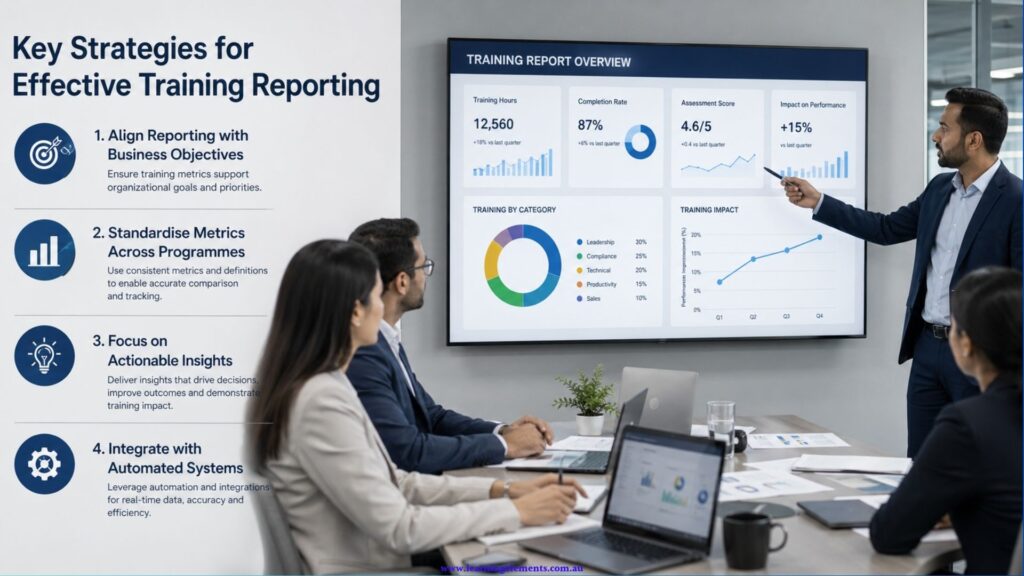
Key Strategies for Effective Training Reporting
1. Align Reporting with Business Objectives
A fundamental principle of training reporting best practices is alignment. Reports should reflect organisational priorities, whether that is increasing productivity, improving customer satisfaction, ensuring compliance, or developing leadership pipelines.
Rather than focusing solely on course completion, consider metrics that answer questions such as:
- How has training improved performance?
- Are employees applying new skills on the job?
- What business outcomes are influenced by learning?
2. Standardise Metrics Across Programmes
Consistency is essential for meaningful analysis. Standardised metrics enable comparisons across departments, time periods, and training initiatives.
Common indicators include:
- Completion rates
- Assessment scores and pass rates
- Skill acquisition or competency levels
- Engagement metrics (e.g. time spent, interaction levels)
3. Focus on Actionable Insights
One of the most common pitfalls in reporting is information overload. Data alone is not valuable unless it leads to action.
Effective training reporting best practices prioritise clarity and relevance by highlighting:
- Key trends over time
- Areas of low engagement or high dropout rates
- Performance gaps and risk areas
- Opportunities for programme improvement
Reports should tell a story, guiding stakeholders towards informed decisions rather than overwhelming them with raw data.
4. Integrate with Automated Systems
Automation is a crucial enabler of modern reporting. By integrating reporting with learning management systems (LMS) and other HR technologies, organisations can ensure data is:
- Accurate and up to date
- Collected consistently across platforms
- Scalable as training programmes expand
As explored in discussions on automated reporting, automation reduces manual effort while enhancing reliability, making it a core component of advanced training reporting best practices.
Ready to apply these training reporting best practices in your organisation? Get expert support to align your reporting with measurable business outcomes.
Common Challenges in Training Reporting
Despite its importance, many organisations struggle to implement effective reporting systems. Common challenges include:
- Fragmented Data Across Systems: Multiple tools and platforms often lead to disconnected data, making it difficult to gain a unified view.
- Over-Reliance on Completion Metrics: Completion rates alone do not reflect learning effectiveness or business impact.
- Lack of Stakeholder-Specific Reporting: Different audiences (e.g. executives, managers, L&D teams) require tailored insights, yet reports are often too generic.
- Limited Data Interpretation: Organisations may collect data but lack the expertise to analyse and translate it into meaningful insights.
These challenges frequently point to gaps in instructional design alignment, unclear learning outcomes, or underutilised LMS capabilities.
Key Services to Strengthen Reporting Capabilities
To overcome traditional barriers and successfully implement training reporting best practices, Australian organisations often leverage specialised services to bridge the gap between raw data and strategic insight. These services ensure that your Learning Management System (LMS) isn’t just a storage vault, but a powerful analytical tool.
Organisations often invest in specialised support, including:
LMS Reporting Configuration
Standard “out-of-the-box” reporting rarely captures the unique nuances of a complex business. Custom configuration involves tailoring dashboards and automated reports to reflect your specific organisational structure and stakeholder requirements. This ensures that a department head sees the team-level data they need, while the C-suite receives high-level summaries of workforce readiness, all from the same platform.
Instructional Design Alignment
Reporting is only as good as the data being captured, and that starts with how a course is built. By aligning instructional design with reporting goals, L&D teams ensure that learning objectives are inherently measurable. This involves embedding specific “data triggers” within digital learning modules, such as scenario-based assessments or confidence-weighted testing, that provide deeper insights into learner competency than a simple “pass/fail” result.
Data Visualisation and Dashboard Design
Raw spreadsheets are often where valuable insights are lost. Professional dashboard design focuses on the art of data storytelling, transforming complex datasets into clear, intuitive, and interactive visuals that drive meaningful action. By using heat maps, trend lines, and progress dials, decision-makers can identify at a glance where skill gaps exist or which regions are falling behind on compliance, allowing for immediate intervention.
Reporting Strategy Development
A robust reporting capability requires more than just software; it needs a blueprint. Strategy development involves creating a structured framework that defines exactly what to measure (KPIs), how to measure it (methodology), and how to communicate those findings to the right people at the right time. This roadmap ensures consistency across the business and shifts the L&D function from reactive reporting to proactive, predictive analysis.
Pro Tip: When developing your reporting strategy, consider the Kirkpatrick Model of evaluation. Moving your reporting from Level 1 (Reaction) to Level 4 (Results) is the ultimate goal of modern training reporting best practices.
Looking Ahead: The Future of Training Reporting
As organisations continue to mature in their data capabilities, training reporting best practices will evolve to incorporate:
- Predictive analytics to forecast skill gaps
- AI-driven insights for personalised learning
- Deeper integration with HR and performance systems
- Real-time dashboards for agile decision-making
These advancements will further strengthen the role of reporting as a strategic function within L&D.
Conclusion
Adopting robust training reporting best practices is essential for organisations that want to maximise the impact of their learning initiatives. By aligning reporting with business objectives, standardising metrics, focusing on actionable insights, and leveraging automation, organisations can transform training data into meaningful intelligence.
Ultimately, effective reporting ensures that learning is not only delivered but also measured, understood, and continuously improved to support both individual growth and organisational success.
Take the next step in advancing your training reporting best practices. Let’s build a reporting framework that delivers clear, actionable insights for your organisation.