
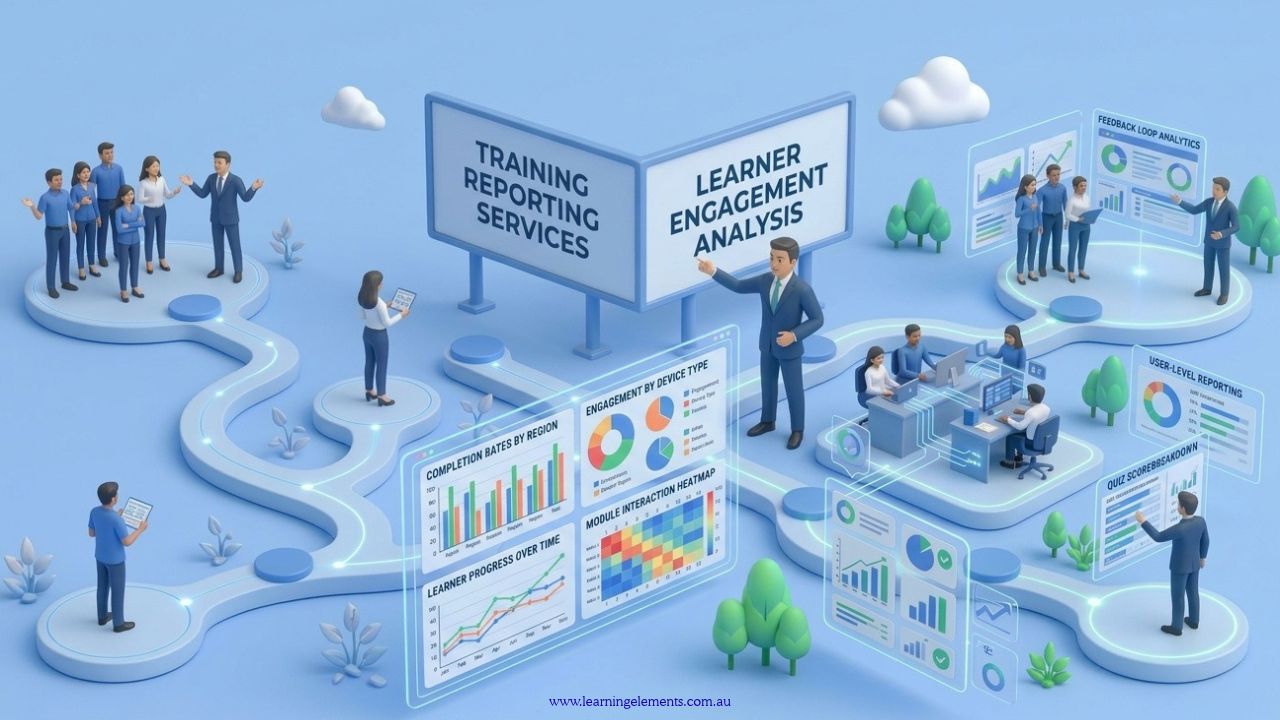
Training reporting and learner engagement analysis can help organisations understand what training has been completed, who participated and how learners interacted with learning content and activities. Training reporting provides information about participation, completion and results, while learner engagement analysis looks more closely at how people interact with training.
For organisations investing heavily in employee training, looking at both areas can provide a clearer picture of participation, progress and potential learning issues. When training data is connected with assessment, workplace behaviour and business measures, it can also help organisations assess whether training is being applied beyond the learning environment.
For Australian businesses, this can be particularly useful where training records need to support operational reporting, workforce development, WHS requirements or internal governance. Safe Work Australia recommends maintaining training records and regularly assessing the effectiveness of training and supervision processes. Specific record-keeping requirements can also vary according to the work, industry and applicable state or territory requirements.
What is training reporting?
Training reporting involves collecting, organising and presenting information about learning activities.
The exact information available depends on the learning management system (LMS), training management system (TMS) or other systems used by an organisation.
Typical training reports may include:
- Enrolments
- Attendance
- Course completion
- Assessment results
- Training hours
- Certification status
- Expired training
- Training by department
- Training by role
- Training costs
- Participation rates
Training reports can help learning and development teams see who has completed required training, identify outstanding activities and provide managers with information about workforce participation.
These reports can support operational requirements, compliance monitoring and management reporting. However, training reporting should not be limited to producing spreadsheets or dashboards. The information needs to be relevant to the people using it. A frontline manager may need to see overdue training, while an L&D leader may need completion trends across departments and senior management may need a higher-level view of participation, costs and outcomes.
What is learner engagement analysis?
Learner engagement analysis looks at how learners interact with training and learning activities.
Depending on the platform and the type of training, this may include:
- Login activity
- Course participation
- Time spent on content
- Assessment attempts
- Discussion activity
- Course progress
- Content completion
- Video interaction
- Survey responses
These measures can help identify patterns that may require further investigation. For example, a high number of learners stopping at the same section of a course could indicate that the content, instructions or technical setup needs to be reviewed.
However, engagement should not be reduced to a single number. A learner who spends less time inside an LMS may still perform well in an assessment. Likewise, frequent logins do not automatically mean that meaningful learning has occurred. Time spent on a page can also be difficult to interpret because an open page or playing video does not necessarily mean that a person is actively engaging with the material.
Research and Australian university guidance have raised concerns about treating observable activity data as direct evidence of learning. Measures such as LMS clicks, page views and time-on-task can provide useful clues, but they do not necessarily show whether meaningful learning has occurred. Australian Catholic University notes that these measures are not the same as learning and should be interpreted in context.
Privacy and transparency are also important considerations. Research involving 2,051 students across six Australian universities reported concerns about the collection and use of certain types of data for learning analytics, with transparency and informed consent identified as key issues.
This means engagement data is most useful when considered alongside assessment results, learner feedback, completion data and other relevant evidence.
What types of training reporting and learner engagement services are available?
Organisations can use different types of services depending on their training environment, reporting requirements and the systems already in place.
LMS reporting
Many learning management systems include built-in reporting tools.
These are often suitable for organisations that mainly need to monitor course participation, completion, assessments and learner progress. Depending on the system, LMS reports can also help identify overdue training and provide managers with information about individual or group participation.
However, built-in reports may not answer every management question. An organisation may have access to a large number of metrics but still struggle to identify which information matters for workforce performance.
Advanced learning analytics
Some learning platforms provide more detailed dashboards and analytics.
These may allow organisations to compare learner groups, identify participation patterns and combine different types of learning data. Depending on the system, organisations may also be able to examine assessment performance, content interaction, survey information and other learning measures.
The purpose should not simply be to collect more data. The goal is to produce information that helps the organisation ask better questions about learning participation, progress and outcomes.
Training management systems
A training management system (TMS) may be suitable for organisations that manage large volumes of structured training, particularly instructor-led programmes.
Depending on the system, reporting may cover areas such as:
- Training schedules
- Attendance
- Instructors
- Venues
- Resources
- Costs
- Course bookings
- Certifications
- Learner records
- Programme performance
A TMS can therefore provide a broader operational view of training where it includes scheduling, attendance, resource, cost and other training-management functions alongside learner information.
Custom reporting and consulting
Some organisations already have an LMS or other training system but struggle to make the reporting useful.
In these cases, the problem may not be the software. It may be the reporting design.
A consulting service can help review existing reports, identify useful KPIs, remove unnecessary metrics and create reporting structures that match management requirements.
For example, an organisation may currently report course completion but also need to understand whether employees passed assessments, applied the skills at work or showed changes in relevant performance measures.
Before purchasing another reporting platform, review your existing systems and identify the specific questions your training reports need to answer.
What should organisations measure?
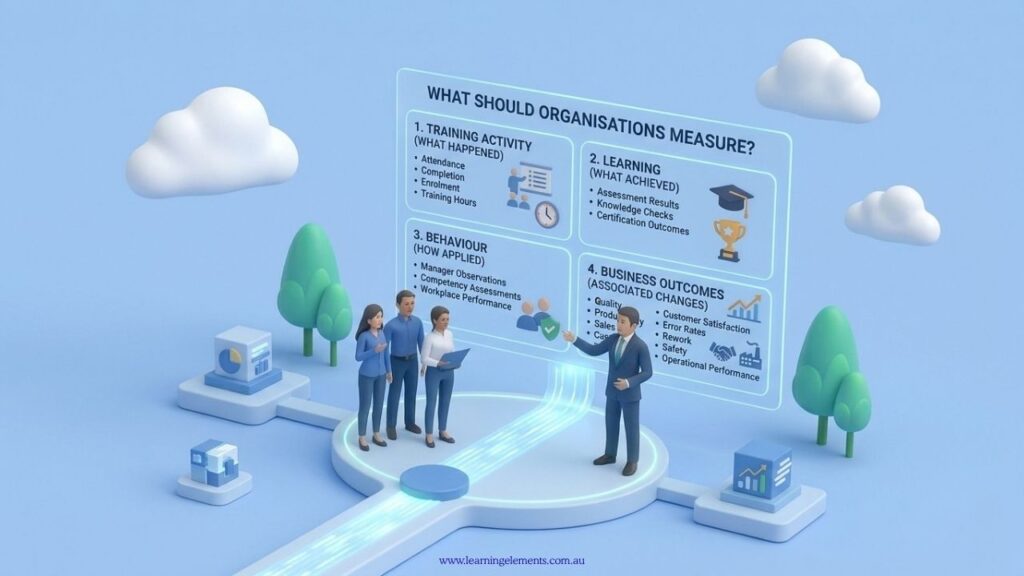
A useful reporting framework can include four broad areas.
Training activity
Measure what happened.
Examples include attendance, completion, enrolment and training hours. These measures provide the basic record of training participation. They can also help identify gaps, such as employees who have not completed required training or courses with unusually low participation.
Learning
Measure what participants achieved.
Examples include assessment results, knowledge checks and certification outcomes. These measures provide more information than attendance alone. Someone attending a course does not necessarily demonstrate that they have understood or retained the material, so assessment and knowledge measures can provide additional evidence where appropriate.
Behaviour
Measure whether learning is being applied at work.
Examples include manager observations, competency assessments and workplace performance measures. Behavioural measures are particularly relevant when the purpose of training is to change how employees perform a task, communicate with customers, manage risks or use a particular process.
For example, completing customer service training is a training activity. Observing whether employees subsequently apply the required customer service behaviours provides a different type of information.
Business outcomes
Measure whether training is associated with changes in relevant business performance.
Depending on the programme, this could include:
- Quality
- Productivity
- Sales
- Customer satisfaction
- Error rates
- Rework
- Safety-related measures
- Operational performance
The appropriate measures will depend on the purpose of the training. Not every training programme should be expected to produce an immediate change in sales or financial results.
The aim is to identify business measures that are reasonably connected to the purpose of the training and can provide useful context alongside learning data. This approach creates a stronger connection between training activity and organisational results without assuming that a change in business performance was caused by training alone.
RELATED READ: Business Performance Improvement: Enhancing Organisational Success Through Effective Training and Coaching
Do not rely on engagement data alone
Analytics can show patterns, but those patterns still need context.
For example, a low completion rate could result from:
- Poor course design
- Lack of available time
- Technical problems
- Irrelevant content
- Poor communication
- Competing work priorities
- A course that is too long
Similarly, a high completion rate does not necessarily mean that employees have gained the intended skills or are applying them at work.
The data identifies an issue. Further investigation is needed to understand why it occurred.
This is why learner engagement analysis works best as part of a wider reporting process. Learner surveys, assessment results, manager feedback, workplace observations and relevant business measures can provide additional information that LMS activity data cannot provide on its own.
How Learning Elements can help
Learning Elements can assist organisations in reviewing training reporting structures and connecting learning data with practical business measures.
This can include:
- Defining reporting requirements
- Identifying relevant KPIs
- Reviewing existing training reports
- Structuring training data for clearer reporting
- Connecting learning measures with behavioural and business measures
- Improving the way training information is presented to managers and decision-makers
- Identifying gaps in existing training reporting processes
The focus is not simply on producing more reports. It is on helping organisations determine what information they need, why they need it and how it can support better training and business decisions.
If your current training reports provide large amounts of data but little useful direction, talk to Learning Elements about your reporting requirements.
How should Australian organisations handle training data?
Training reporting may involve personal information, particularly where reports contain individual names, employee identifiers, assessment results or detailed learner activity.
Australian organisations should consider the privacy requirements that apply to the information they collect, use and disclose. The requirements can depend on the organisation, the type of information involved and the circumstances in which it is handled.
The position can also depend on the type of organisation and the circumstances in which employee information is handled. For this reason, organisations should not assume that every piece of learner data can be collected or analysed simply because a system makes it technically possible. Reports should collect information that has a clear business or operational purpose, with appropriate access controls and data handling practices.
Conclusion
Training reporting and learner engagement analysis serve different purposes, but they can work together.
Training reporting shows what happened, such as who enrolled, attended or completed training. Engagement data can show how learners interacted with training content and activities. Assessment, behavioural and business measures can then provide additional context about learning and its application.
A useful reporting system should connect these areas rather than treating every LMS activity as proof of learning.
For Australian organisations, the right approach will depend on the type of training, workforce, systems, reporting requirements and applicable obligations. The most useful reporting framework is one that turns relevant training data into information that managers, L&D teams and decision-makers can actually use.
If you are reviewing your training analytics, consider not only what your system can measure, but also whether each metric is necessary, useful and appropriate for the purpose for which the information is being used.
Sources:
- Inspire – Australian Catholic University: Learning Analytics
- Flinders University: Perspectives from the stakeholder: Students’ views regarding learning analytics and data collection – West, D., Luzeckyj, A., Searle, B., Toohey, D., Vanderlelie, J., & Bell, K. R. (2020). Perspectives from the stakeholder: Students’ views regarding learning analytics and data collection. Australasian Journal of Educational Technology, 36(6), 72-88. https://doi.org/10.14742/ajet.5957
- Safe Work Australia: Provide ongoing training and supervision
- Australian Government – The Office of the Australian Information Commissioner (OAIC): Privacy guidance for organisations and government agencies
Frequently Asked Questions
- What is training reporting? Training reporting is the process of collecting and presenting information about training activities. Reports may include enrolments, attendance, completion, assessment results, training hours, certification status and participation by department or role.
- What is learner engagement analysis? Learner engagement analysis examines how people interact with training content and activities. Depending on the system, this can include course progress, content completion, assessment attempts, video interaction, participation and survey responses.
- What is the difference between training reporting and learning analytics? Training reporting generally focuses on recording and presenting information about training activities and results. Learning analytics can involve analysing different types of learning data to identify patterns, relationships or areas that may need attention. The terms can overlap, and the exact meaning depends on how a platform or organisation defines its reporting and analytics functions.
- How can Australian businesses use training reporting for compliance? Training reports can help organisations maintain evidence of relevant training, identify overdue or incomplete training and provide records for internal monitoring. Safe Work Australia recommends keeping records of training and states that WHS laws require training records for certain tasks. Specific requirements depend on the applicable legislation, industry and jurisdiction.
- How can organisations measure learner engagement effectively? Organisations can use a combination of engagement indicators rather than relying on one metric. Course progress, completion, assessment attempts, learner feedback and relevant workplace measures can provide a broader view. Engagement data should be interpreted in context because activity such as logins or time spent in a course does not automatically demonstrate meaningful learning.