
Small and medium-sized businesses often ask, “Who supplies training reporting tools tailored to their needs?” They may need to track mandatory training, employee development, course completion, certifications and assessment results without the complexity or administration associated with some larger enterprise systems.
The right training reporting tool depends on the size of the workforce, the type of training delivered and the level of reporting required. For many small to medium-sized businesses, a practical solution should provide the reporting features they need while remaining manageable for HR, L&D and training teams.
What should small and medium-sized businesses training reporting system provide?
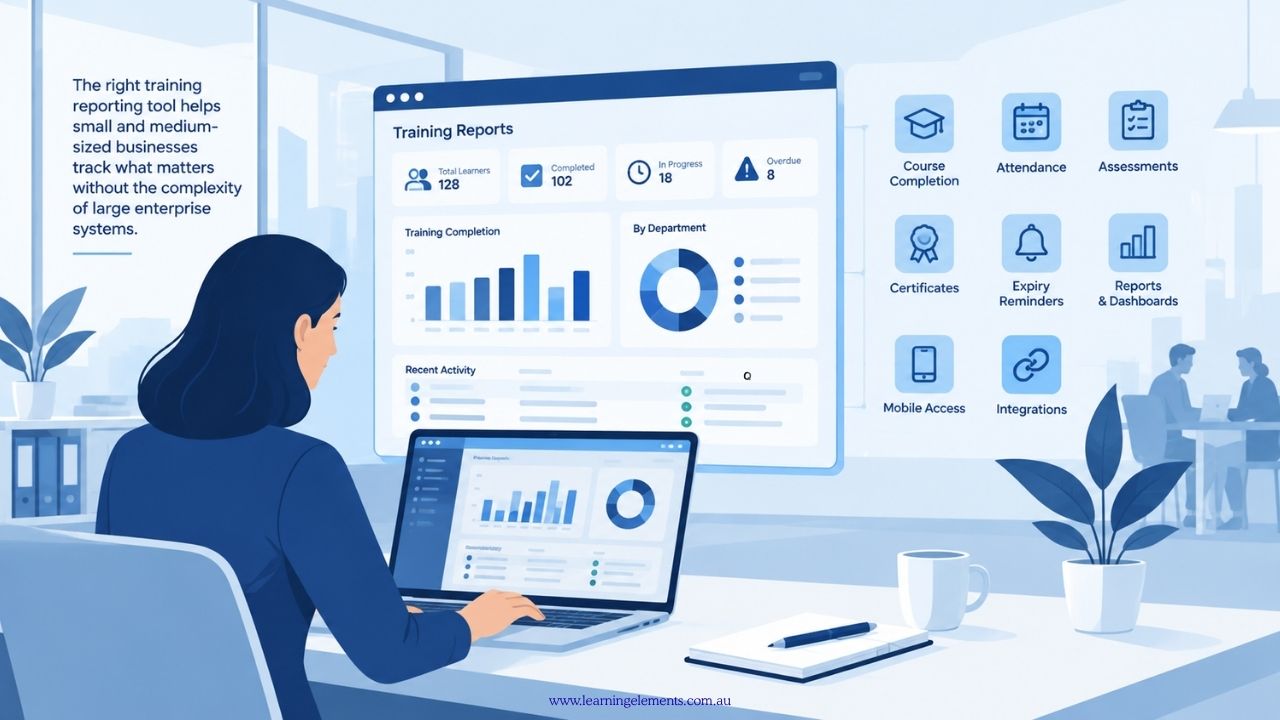
A small or medium-sized organisation may need:
- Employee training records
- Course completion
- Attendance
- Assessments
- Certificates
- Expiry reminders
- Basic dashboards
- Reports by department
- Data exports
- Mobile access
- Integrations
The organisation may not need every advanced enterprise feature. The most suitable training reporting tools should provide the core functions needed to manage training records and monitor participation without creating unnecessary administration.
Reporting should also be easy for HR, L&D or training staff to access and understand. For growing businesses, it can be useful to choose a system that allows additional reporting features or integrations to be added as requirements change. When comparing who supplies training reporting tools, businesses should focus on whether the provider’s features match their actual training and reporting needs.
Start with the number of learners
User numbers can have a major effect on software pricing. Some vendors offer plans designed around specific user numbers, while others provide customised pricing. TalentLMS, for example, currently offers a free plan for limited users and courses. This gives very small organisations an option for testing basic LMS functionality before considering a paid plan. LearnWorlds currently offers paid plans with reporting and analytics features, with additional capabilities available at higher plan levels. Pricing and plan features can change, so businesses should check the provider’s current pricing before making a purchasing decision.
The number of learners is therefore one of the factors to consider when comparing who supplies training reporting tools. A business with a small workforce may only need a basic plan, while a growing organisation may require more users, reporting options or administrative accounts over time.
Consider the type of training
An organisation delivering mainly online courses may need an LMS. A business running regular classroom or instructor-led programmes may need a training management system. An organisation delivering both may need a platform that supports blended learning.
For example, Training Orchestra focuses on training operations such as scheduling, resource management, instructor collaboration and reporting alongside other training functions.
The type of training being delivered can therefore influence which suppliers are suitable for small and medium-sized businesses. Businesses should consider whether they need to report on online learning, classroom attendance, assessments, instructor-led sessions or a combination of these activities. Choosing a system based on actual training delivery methods can help prevent businesses from paying for features they are unlikely to use.
Think about reporting before buying
A small business may start with simple questions:
- Who has completed induction?
- Who is overdue?
- Which certificates expire soon?
- How much training has each employee completed?
- Which courses have the highest participation?
As the organisation grows, reporting needs may become more detailed. The system should therefore provide enough flexibility to accommodate reasonable growth without forcing the organisation into unnecessary complexity. Before choosing a provider, businesses should check whether the reports answer the questions their managers and training teams actually need. It can also be useful to check whether reports can be filtered by employee, department, course, date or completion status. When considering who supplies training reporting tools, the reporting functions should be assessed alongside the overall usability and cost of the system.
RELATED READ: Compare Training Reporting Solutions for Small Businesses
Check mobile access
For businesses with mobile, field-based or shift-based employees, mobile access can be important. Employees may need to complete short courses from phones or tablets. Managers may also need quick access to completion information. When comparing who supplies training reporting tools, businesses should check whether mobile access covers both learning and the reporting information managers need. It is also worth testing the actual courses, assessments and reports on the devices employees are likely to use. This can help identify compatibility or usability issues before the organisation commits to a system.
If mobile access is an important part of your training process, Learning Elements can help you assess what your team needs from a training reporting system.
Discuss Your Training Reporting Needs
Check integrations
Small and medium-sized businesses (SMBs) often already use several cloud systems.
These might include:
- Payroll
- HR software
- Accounting
- CRM
- Microsoft 365
- Google Workspace
- Video conferencing
- Business intelligence tools
The training system does not necessarily need to integrate with every application, but it should work with the systems that are important to the organisation’s processes.
Look at implementation requirements
A low monthly subscription does not always mean low total cost.
Ask about:
- Setup
- Data migration
- Administrator training
- Support
- Integrations
- Customisation
- Additional users
- Reporting upgrades
Also determine who will manage the platform internally.
If no one has responsibility for maintaining employee records and reviewing reports, even a simple system can become difficult to manage.
Consider whether you need consulting support
Sometimes the issue is not finding software. An organisation may already have an LMS but use only a small part of its reporting capabilities. Before replacing the system, review what it currently provides. You may find that the existing platform can produce the required reports with better configuration, cleaner data or a revised reporting structure.
This is an important consideration when deciding who supplies training reporting tools because changing platforms is not always the best solution. A review of the current system may show that the organisation already has useful reporting functions that are not being fully used. It may also identify gaps in the data, report structure or processes that need to be addressed before investing in new software.
Learning Elements can help businesses review their existing training reporting process, clarify what information they need and identify practical improvements. This can give decision-makers a clearer basis for deciding whether to improve the current system or consider another provider.
Book a Training Reporting Consultation
Popular Australian Training Reporting Providers
- Tribal Habits: An Australian-owned learning platform with local hosting, active-user pricing, AU/NZ compliance content, and reporting for quiz scores, tasks, requirements and training progress.
- Sentrient: Built specifically for Australia and New Zealand, featuring pre-loaded compliance courses and policies tailored to local state and federal legislation.
- Coassemble: An Australian learning platform focused on course creation, delivery, learner tracking and reporting features for teams.
- Moodle:A widely used open-source learning platform. Moodle Workplace adds features such as multi-tenancy, certifications, reporting and organisational management for workplace training.
- Acorn PLMS: An AI-supported performance learning management platform featuring capability-based learning, competency tracking, reporting and analytics for organisational learning and development.
RELATED READ: Top Platforms Offering Training Reporting Features for Businesses
How Learning Elements can help
Learning Elements can help small and medium-sized businesses review their training reporting requirements, identify useful measures and structure training information around business needs. This can include looking at the number of learners, types of training delivered, completion and attendance requirements, certification tracking and the reports managers need to monitor training activity.
We can also help businesses consider whether their current platform provides the right information or whether a different approach may be more suitable. This can be useful when an organisation is selecting a new system or trying to get more value from its existing training platform. Rather than focusing only on the features a provider offers, businesses can first identify what they actually need to track and report.
If you are unsure what type of training reporting system your business needs, talk to Learning Elements about your current process and reporting requirements. Book a consultation with Learning Elements to discuss your training reporting needs and how your current or planned system can support your business.
Conclusion
Small and medium-sized businesses do not necessarily need the most complex training reporting platform. The better starting point is to identify the training information the organisation actually needs, then select software that can provide it at an appropriate level of cost and complexity. Consider learner numbers, training delivery methods, reporting requirements, mobile access, integrations and future growth before making a decision.
When comparing who supplies training reporting tools, businesses should look beyond the number of features offered and consider whether the system fits their actual training process. A suitable platform should make it easier to maintain training records, monitor completion and produce useful reports without adding unnecessary administration.
If you are unsure whether your current platform is suitable, or you need help defining your training reporting requirements before choosing a provider, Learning Elements can help you review your needs and discuss practical options.
Sources:
- Australian Government Australian Skills Quality Authority: VET activity data reporting
- TalentLMS: Pricing
- LearnWorlds: Features
- Training Orchestra: Products & Features
- Tribal Habits: Reporting and Analytics
- Sentrient: Simplify Your Compliance with the All-in-One Compliance System
- Coassemble: Reporting FAQ
- Moodle: Moodle Workplace documentation
- Acorn: Reporting & Analytics
- RTObase: RTO software, explained.
- RTOPilot: The Importance of Using AVETMISS-Compliant Software for RTOs