
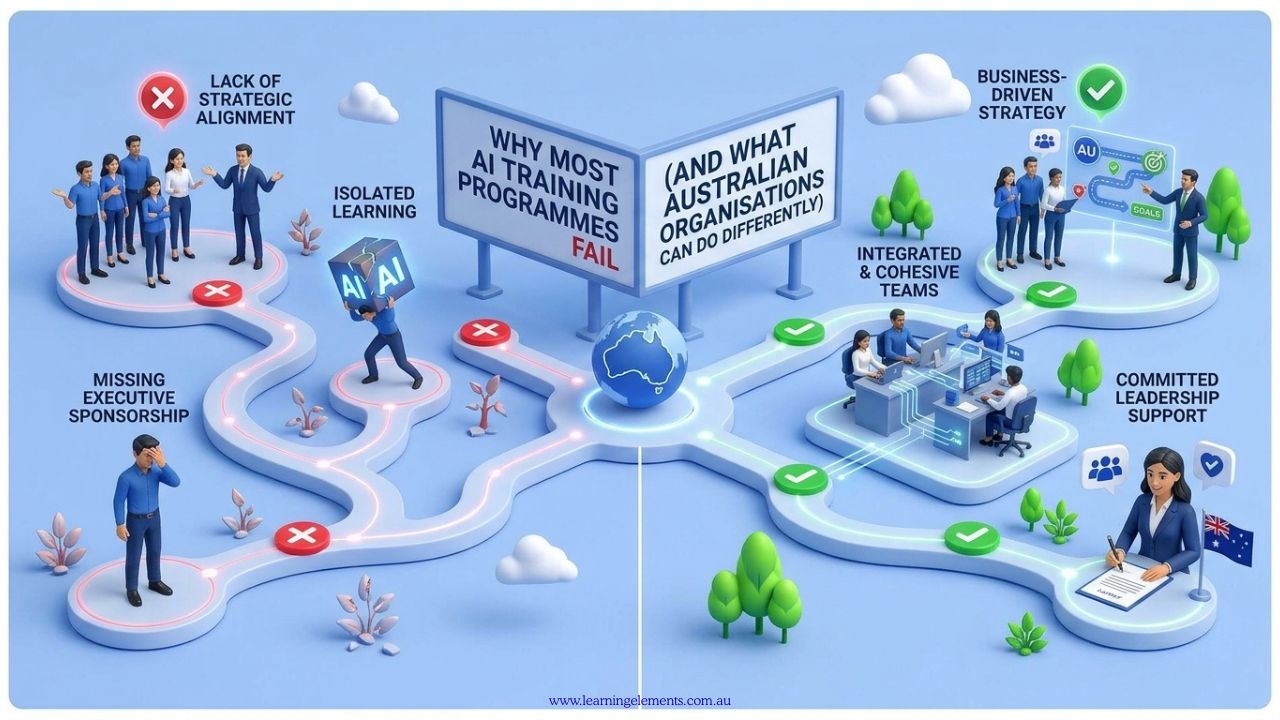
AI training is becoming a priority for organisations across industries. Employees are being introduced to generative AI tools, prompting techniques, automation and new ways of working at a pace few learning teams have seen before.
Yet giving employees access to training does not automatically create AI capability.
A training programme can have strong attendance, positive feedback and a 100% completion rate, yet still produce little measurable change in workplace behaviour or business performance.
The problem is what happens before, during and after the training.
This issue is also reflected in current Australian Government guidance. The Australian Government’s Guidance for AI Adoption recommends that organisations identify AI training needs, address capability gaps and regularly check that AI skills remain current as AI use evolves. It also highlights the importance of leadership, communication and monitoring whether organisational expectations are understood and followed.
AI Training Is Not the Same as AI Capability
Training provides an opportunity to develop knowledge and skills.Capability requires something more.
Employees need to understand what they have learned, practise it, apply it to their work, receive feedback and continue using it.
This distinction is important when organisations assess AI training programmes.
A course completion report may tell you who attended.
It does not necessarily tell you:
- Who can apply the skill
- Who is using it at work
- Whether behaviour has changed
- Whether managers are reinforcing it
- Whether performance has improved
- Whether the training supported business objectives
7 Reasons Why AI Training Programmes Fail
1. One-Off Workshops Do Not Create Lasting Capability
A workshop can be useful for introducing a new topic.
The problem occurs when an organisation assumes that one session is enough to change how employees work.
AI tools and use cases can change quickly. Employees also need time to practise.
A single workshop may introduce prompting, AI concepts or responsible AI use, but employees still need opportunities to apply these skills.
A stronger approach
Instead of relying on one event, organisations can create a learning journey that includes:
- Initial training
- Practical exercises
- Workplace application
- Coaching
- Peer learning
- Follow-up resources
- Assessments
- Manager reinforcement
- Refresher learning
This gives employees multiple opportunities to practise and apply what they have learned in the workplace.
2. Training Is Not Connected to Real Work
Generic AI training can be difficult for employees to transfer into their roles.
A finance employee, HR manager, sales professional and operations team may all need different AI applications.
If training remains theoretical, employees may understand the concepts without knowing how to use them in their actual work.
Better questions to ask
Instead of asking:
“What AI course should employees complete?”
Ask:
“What work do we want employees to perform differently?”
Then identify the skills required to achieve that change.
For example, an organisation might identify that its HR team needs to improve:
- Drafting and reviewing documents
- Analysing employee data
- Creating interview questions
- Summarising information
- Identifying patterns
- Supporting managers with workforce information
The learning programme can then be designed around those actual requirements.
3. Leaders Are Not Involved
Employees can receive mixed signals when senior leadership promotes AI adoption but managers do not reinforce it in day-to-day work.
Leadership may communicate that AI is an organisational priority, but employees also need to understand what that priority means for their specific roles. Managers are often the people who can connect a broad AI strategy with the practical realities of the team’s work.
Managers can help employees understand:
- Why the organisation is adopting AI
- Which AI use cases are relevant to their roles
- Which uses are appropriate and which are not
- What is expected of them after training
- How AI may change existing tasks and workflows
- Where employees can ask questions or raise concerns
- How new skills will be supported and reinforced
This does not mean every manager needs to become an AI specialist. It means managers need enough understanding to support employees as they apply new skills to their work.
For example, an employee may complete training on using generative AI to prepare reports. If their manager continues to expect the same process and provides no opportunity to use the new skill, the training may have little effect on actual work.
Managers can reinforce learning by discussing practical use cases, reviewing workplace applications, providing feedback and identifying barriers that prevent employees from applying what they have learned.
Leadership also needs to provide a clear organisational direction. Employees need to know how AI fits within existing policies, processes, risk controls and business priorities. Without this support, AI training can remain separate from the way work is actually managed.
4. There Is No Behaviour Change Strategy
Knowing how to use an AI tool does not automatically mean an employee will change how they work.
An employee may understand how to write an effective prompt, summarise a document or use AI to support a particular task. However, they may return to their previous way of working because it feels more familiar, they are unsure whether AI is permitted, they do not have enough time to practise or their manager does not encourage its use.
Behaviour change involves more than transferring knowledge.
Employees may need to develop confidence, practise new skills, receive feedback and understand how those skills fit into their existing workflows. They may also need changes to processes, technology access, policies or manager expectations.
A practical AI training programme should therefore consider what happens after the learning session.
This could include:
- Workplace assignments based on real tasks
- Guided practice using approved AI tools
- Coaching and feedback
- Peer learning and communities of practice
- Manager check-ins
- Follow-up assessments
- Refresher learning
- Opportunities to share successful use cases
- Review of barriers preventing application
The organisation should also decide what behaviour it expects to see after training.
For example, rather than simply asking whether employees completed an AI prompting course, an organisation could ask whether employees are using the techniques appropriately in relevant work tasks, whether their use is consistent with organisational requirements and whether the new approach is improving the way those tasks are performed.
This creates a clear link between learning and workplace application. The aim is not to make employees use AI for the sake of using it. The aim is to support appropriate changes in how work is performed where AI can provide genuine value.
5. Organisations Measure Completion Instead of Impact
Completion rates are easy to measure. They are also only one part of the picture.
A completion report can tell an organisation how many employees attended a session or finished an online module. It cannot, on its own, show whether employees developed the required capability, applied it at work or contributed to a relevant business outcome. This is particularly important for AI training because completing a course does not necessarily mean an employee can use an AI capability effectively in their role.
A useful measurement approach can move through several levels:
- Learning
- Application
- Behaviour
- Performance
- Business impact
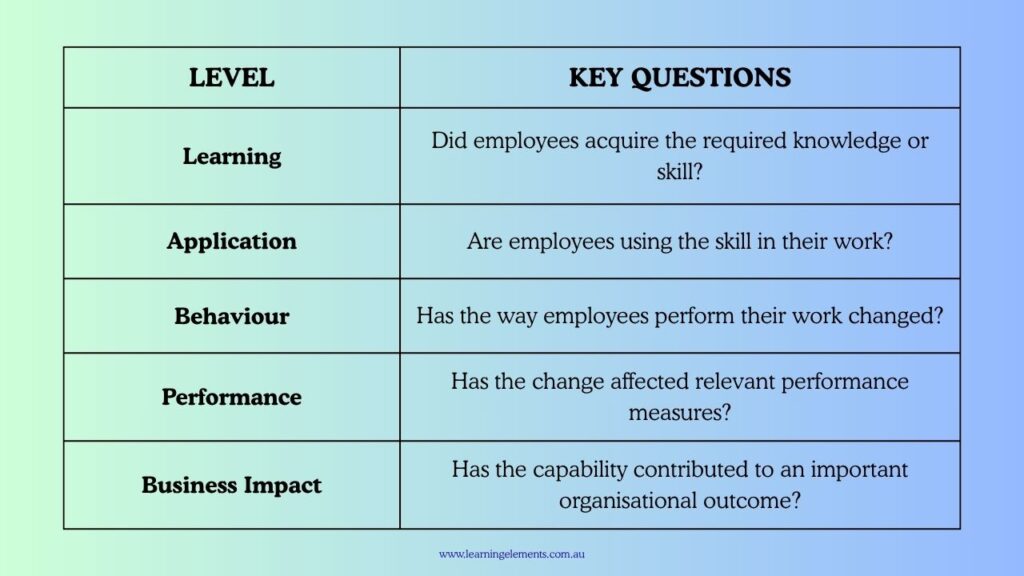
The measures will vary depending on the purpose of the training.
For example, an organisation introducing AI-assisted document processing could monitor whether employees are using the approved process, whether processing times have changed, whether error rates have changed and whether the quality of the resulting work remains appropriate.
The point is not to attach a financial figure to every learning activity. Some training may have objectives related to compliance, risk reduction, employee confidence, quality or capability rather than direct revenue.
The important question is whether the organisation has enough relevant evidence to understand what happened after the training.
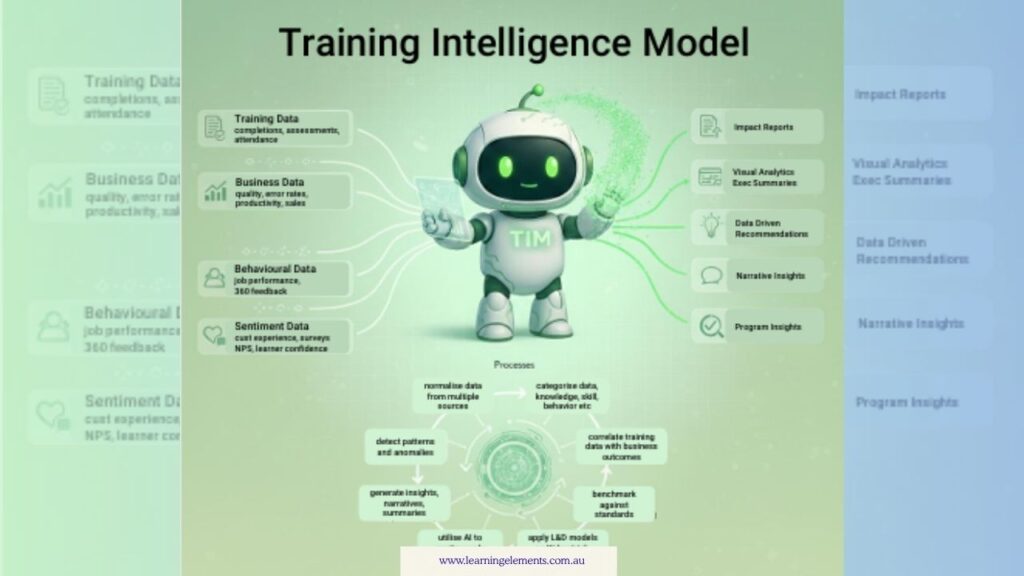
This is where the Training Intelligence Model (TIM) can support a broader view of training data.
Using TIM to Connect Training With Performance
The Training Intelligence Model can help organisations move beyond basic training reporting.
TIM brings together training, behavioural, sentiment and business data to help organisations identify patterns, compare related measures and understand how learning connects with workplace and business outcomes.
Instead of stopping at:
“92% of employees completed the AI training.”
the organisation can ask:
“What changed after employees completed the training, and what evidence do we have?”
That shift moves training reporting from participation data towards a more useful view of capability, performance and business impact.
For example:
- Training data: Completions, attendance and assessment results show participation and learning.
- Behavioural data: Job performance and other behavioural indicators can show whether employees are applying the capability in their work.
- Sentiment data: Surveys, learner confidence and relevant feedback can show how employees are responding to the change.
- Business data: Quality, error rates, productivity, sales and other relevant measures can show whether changes in capability are associated with business outcomes.
Bringing these four data layers together can give Australian organisations a broader picture of how training relates to workplace behaviour, employee sentiment and business outcomes.
RELATED READ: How to Generate Training Completion Reports for Workplace Safety
6. Training Is Not Updated as Needs Change
AI capability requirements shift quickly. New tools appear. Existing tools gain new features. Organisations identify new use cases. Policies change. A training programme designed once and left unchanged can become outdated as tools, policies, use cases and organisational requirements change.
Updating a programme doesn’t mean rebuilding it from scratch every few weeks.
It means regularly checking whether:
- Learning objectives remain relevant
- Examples reflect current tools and current work
- Policies referenced in training are still accurate
- Skills taught still match business requirements
- Employees have developed new capability gaps
- Performance data is pointing to new learning needs
7. Employees Are Not Given Permission to Practise
Employees need safe opportunities to test new AI skills without fear of getting it wrong in front of a client, a manager or a compliance team. Without genuine practice, employees may understand AI concepts intellectually but remain too hesitant to apply them in real work.
Organisations can create safe opportunities through:
- Practical exercises
- Simulations
- Team-based projects
- AI experimentation sessions
- Role-based challenges
- Communities of practice
- One-on-one coaching
The purpose is not experimentation for its own sake. The aim is to connect practice to meaningful work.
What a Stronger AI Training Programme Looks Like
A stronger programme begins with the business problem, rather than starting with an AI tool or a training course.
Before deciding what employees should learn, organisations should identify what they want to improve, who is affected, what capabilities are required and how they will know whether the change has occurred.
A practical approach can follow eight steps.
Step 1: Identify the Business Need
What needs to improve?
Start with the business problem.
The organisation might want to reduce administrative workload, improve the quality of written outputs, reduce processing errors, support faster analysis or improve another measurable aspect of performance.
The purpose of the AI training should connect to that need.
This also prevents organisations from choosing training simply because a particular AI tool is available. The question should be what the organisation needs to improve and whether AI capability can contribute to that improvement.
Step 2: Identify the Roles Affected
Who needs to change how they work?
Not every employee will use AI in the same way.
Different roles may have different tasks, responsibilities, risks and opportunities. A finance team may have different requirements from an HR team, sales team, customer service team or operations team. Identifying the roles affected helps organisations determine who needs training, what type of training is relevant and where additional support may be required.
Step 3: Identify the Required Capabilities
What knowledge, skills and behaviours are needed?
Once the affected roles are clear, identify what employees actually need to be able to do. This could include knowledge of AI concepts, practical tool skills, prompt development, information checking, responsible AI use, data handling or role-specific applications. It can also include behaviours such as reviewing AI-generated outputs, following organisational requirements and knowing when human judgement is needed.
This step turns a broad goal such as “improve AI literacy” into specific capabilities that can be developed and assessed.
Step 4: Design Relevant Learning
What training, practice and support will develop those capabilities?
The learning should reflect the capabilities identified in the previous step. Depending on the need, this could include workshops, self-paced modules, practical exercises, simulations, coaching, job aids or follow-up activities. Practical application should be part of the design rather than something left entirely to employees after the course. Employees should have opportunities to practise the skills using tasks that are relevant to their actual work.
Step 5: Involve Managers
How will managers reinforce application?
Managers should have a clear role in what happens after training. They can help employees identify suitable opportunities to apply new skills, discuss progress, provide feedback and raise barriers that may prevent application. Manager involvement also helps connect training with team priorities and day-to-day work. The organisation should be clear about what managers are expected to reinforce rather than assuming that support will happen automatically.
Step 6: Measure Application
Are employees using the capability?
This is where organisations move beyond completion data. Look for evidence that employees are applying what they learned in appropriate work situations. Depending on the training, this could include assessments, work samples, manager observations, workflow data, surveys or other relevant measures. The measures should reflect the capability being developed rather than simply counting participation.
Step 7: Measure Performance
What has changed as a result?
Application is important, but organisations should also consider whether the change is associated with better performance. Relevant measures could include quality, error rates, productivity, processing time, sales, customer measures, employee confidence or other business indicators. Not every measure will apply to every training programme. The important point is to select measures that relate to the original business need.
This is also where TIM’s approach to connecting training, behavioural, sentiment and business data can help provide a broader view of what is happening.
Step 8: Adjust the Programme
What does the evidence tell us about the next development need?
Training should not be treated as finished once employees complete the programme. Evidence from assessments, workplace application, behavioural indicators, sentiment and business measures can identify areas where further support may be needed. Some employees may need additional practice. A particular team may need manager support. A learning activity may need to be updated. The organisation may also identify a new capability gap as AI use develops. The next training decision should therefore be informed by evidence from the previous cycle.
This creates a continuous process:
Identify the need → build capability → apply the capability → measure what changed → identify the next need.
That is a more useful approach than treating AI training as a one-off event.
The Real Goal of AI Training
The goal of AI training should be more than simply teaching employees how to use a new tool.
The real goal is to help people develop the knowledge, skills and behaviours they need to perform their work effectively, while using AI appropriately, safely and responsibly.
That requires more than a training session. Organisations need to understand the business need, identify the capabilities required, support employees as they apply new skills, involve managers, and measure what changes after the learning takes place.
Completion rates can show who participated. They cannot, on their own, show whether employees are applying what they learned or whether that application is contributing to better performance.
A stronger approach connects learning with application, behaviour, performance and business outcomes. This gives organisations a clearer basis for deciding what is working, where gaps remain and what needs to happen next.
How Learning Elements Can Help
Learning Elements takes a capability-focused approach to training design and development.
Through needs analysis, learning design, leadership development and the Training Intelligence Model, Australian organisations can look beyond participation data and consider whether learning is transferring into workplace behaviour and performance. The focus is not simply on whether employees completed their training. It is on understanding what capabilities the organisation needs, how employees are applying those capabilities and what the available evidence shows about changes in behaviour and performance.
The Training Intelligence Model supports this approach by bringing together training, behavioural, sentiment and business data. This can help organisations identify patterns, understand where capability gaps remain and consider how training relates to broader business outcomes.
Discuss your training requirements with Learning Elements
Turn AI Training Into Measurable Workplace Capability
If your organisation has invested in AI training but isn’t yet seeing it translate into changed behaviour or business results, the issue may not be the training content. It may be the system around it.
The Training Intelligence Model brings together training, behavioural, sentiment and business data to help organisations identify patterns, understand what is changing and consider how learning relates to workplace and business outcomes.
Conclusion
AI training is most useful when it is treated as part of a broader capability-building process rather than a one-off learning event. Employees need relevant training, opportunities to practise, support from managers and clear expectations about how new skills should be applied. Organisations also need to measure more than attendance and completion if they want to understand whether training is making a difference.
For Australian organisations, this means connecting the initial business need with the capabilities employees require, the way those capabilities are applied at work and the performance measures that matter to the organisation. The question is therefore not simply whether employees completed AI training. It is whether they developed the capability they needed, applied it appropriately and whether there is evidence that meaningful change occurred.
That is the shift from measuring training activity to understanding training impact.
Sources:
- Australian Government – National AI Centre: Guidance for AI adoption: implementation guidance