




Strategic Sales Planning: A Roadmap to Sustainable Revenue Growth
What Is Strategic Sales Planning?
Strategic sales planning is a deliberate and systematic approach to defining sales goals, identifying target audiences, and developing actionable strategies that align with the broader business mission. It acts as a bridge between strategic objectives and frontline execution, ensuring every sales activity contributes to sustainable revenue growth.
Strategic sales planning involves anticipating market shifts, understanding customer behaviours, and crafting adaptable sales models that drive consistent business performance. It’s not just about selling more, but about selling smarter.
Key Elements of Strategic Sales Planning
1. Setting Clear Sales Goals
Establishing specific, measurable, achievable, relevant, and time-bound (SMART) goals forms the foundation of effective strategic sales planning.
- Align sales objectives with company vision and financial targets.
- Set measurable outcomes, such as revenue growth, customer acquisition rates, and retention improvements.
- Use data insights and predictive analytics to establish realistic yet ambitious milestones.
Clear sales goals foster accountability and provide direction for sales teams, ensuring their efforts are both focused and impactful.
2. Identifying Target Markets and Ideal Customers
The next step in strategic sales planning is understanding who to sell to. Without precise targeting, even the best strategies fall short.
- Conduct comprehensive market research to uncover emerging trends and customer needs.
- Develop detailed buyer personas, considering demographics, pain points, and motivations.
- Segment customers into distinct groups for personalised communication and offers.
This approach allows businesses to optimise marketing and sales alignment, improving conversion rates and long-term loyalty.
3. Developing a Sales Strategy
Once target audiences are identified, it’s time to define the overall sales strategy.
- Choose the right sales model—inside sales, field sales, B2B, or B2C.
- Employ a multi-channel approach using email, phone, social media, and in-person interactions.
- Leverage content marketing and social selling to establish authority and trust.
A robust sales strategy ensures consistent messaging and cohesive execution across all channels, amplifying brand credibility and driving measurable outcomes.
4. Optimising Sales Processes
Efficiency is a key pillar of strategic sales planning. Streamlining processes can significantly improve productivity and revenue outcomes.
- Automate repetitive tasks using CRM systems and AI-powered tools.
- Create a well-defined lead qualification framework to prioritise high-value opportunities.
- Continuously monitor pipeline health to detect and address bottlenecks early.
These improvements reduce inefficiencies, allowing sales teams to spend more time nurturing leads and closing deals.
5. Training and Coaching Sales Teams
A successful strategic sales plan thrives on the capabilities of the people executing it.
- Provide ongoing training on product knowledge, negotiation, and communication.
- Implement sales coaching programmes to enhance performance and confidence.
- Foster a growth mindset culture that values continuous learning.
A well-trained team can adapt to market changes and maintain consistency in delivering high-quality customer interactions.
6. Measuring and Adjusting Sales Performance
Continuous performance measurement ensures that your strategic sales planning efforts remain aligned with evolving market realities.
- Track key performance indicators (KPIs) such as conversion rates, customer lifetime value, and deal size.
- Use data analytics to measure sales productivity and effectiveness.
- Adjust strategies based on insights gained to maintain momentum.
This iterative approach allows businesses to stay agile, refine their processes, and sustain long-term profitability.
Advanced Components of Strategic Sales Planning
7. Integrating Technology and Automation
In modern strategic sales planning, technology plays a transformative role.
- Adopt AI-driven CRMs for predictive forecasting and lead scoring.
- Use sales enablement platforms to streamline content sharing and tracking.
- Automate routine tasks such as follow-ups and reporting.
Embracing automation empowers teams to focus on relationship building and value-driven interactions.
8. Aligning Sales and Marketing Teams
A successful strategy demands cross-departmental alignment.
- Establish a shared pipeline visibility between marketing and sales teams.
- Create joint KPIs such as lead quality and conversion ratios.
- Encourage consistent communication to avoid duplicate efforts and misaligned messaging.
This synergy improves lead nurturing and accelerates the sales cycle.
9. Forecasting and Budget Allocation
Accurate forecasting is the backbone of any strategic sales plan.
- Use historical data and market insights to project future sales trends.
- Allocate resources effectively—ensuring optimal budget utilisation across campaigns.
- Reassess forecasts quarterly to adjust for economic or market fluctuations.
With reliable forecasts, businesses can make informed decisions that drive scalability and stability.
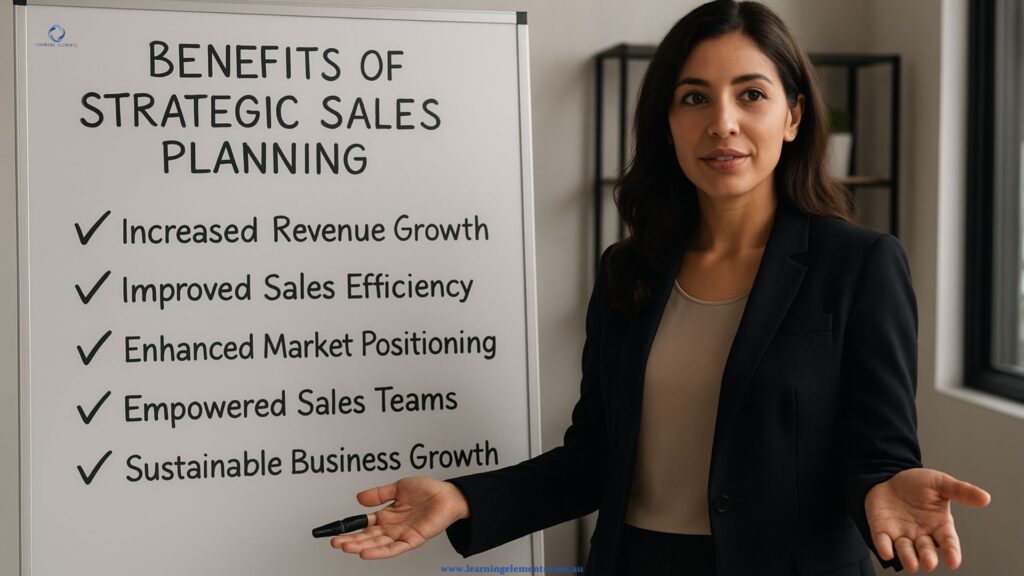
Benefits of Strategic Sales Planning
Strategic sales planning delivers a range of advantages that directly impact business performance, team productivity, and long-term sustainability.
1. Increased Revenue Growth
A strong strategic sales planning framework ensures that every sales activity is intentional, targeted, and aligned with measurable objectives. When teams understand who they are selling to, how to position solutions, and what core actions drive conversions, revenue naturally increases. Businesses benefit from:
- More accurate sales forecasting
- Higher-quality leads entering the pipeline
- Improved conversion rates through tailored messaging
- Consistent focus on profitable customer segments
This creates predictable revenue streams and supports aggressive growth targets.
2. Improved Sales Efficiency
Well-defined processes reduce time wasted on low-value activities. With streamlined workflows and automation tools embedded in the strategic sales planning process, sales teams can:
- Prioritise high-intent leads
- Reduce manual administrative tasks
- Enhance follow-up speed and effectiveness
- Maintain accurate, real-time data
Efficiency gains free up salespeople to focus on customer relationships and deal closing rather than repetitive tasks.
3. Enhanced Market Positioning
Strategic clarity allows organisations to position themselves uniquely in the market. By understanding competitive landscapes and leveraging data insights, businesses can:
- Tailor value propositions to market needs
- Anticipate shifts in customer behaviour
- Strengthen brand authority through consistent messaging
- Ensure offerings remain relevant and differentiated
The result is a more compelling and competitive market presence.
4. Empowered and High-Performing Sales Teams
Sales teams perform better when they operate within structured systems that support their success. Strategic sales planning enhances capability through:
- Continuous training and coaching
- Clear performance metrics and expectations
- Better access to sales enablement tools
- A motivating environment built on transparency and accountability
Empowered teams close more deals, enjoy higher job satisfaction, and contribute to a stronger sales culture.
5. Sustainable Business Growth
Because strategic sales planning aligns sales goals with broader organisational objectives, it promotes long-term stability and growth. Businesses enjoy:
- Consistency in revenue performance
- Scalable sales infrastructure
- Stronger customer retention
- A proactive rather than reactive approach
Sustainability emerges from deliberate planning, effective execution, and continuous optimisation.
Take Your Sales Team to the Next Level with Expert Training
If your organisation is ready to strengthen sales performance, enhance capability, and embed a structured approach to selling, we can help. At Learning Elements, we design tailored sales training programmes that equip teams with the practical skills, tools, and confidence needed to execute a winning sales strategy.
Whether you need customised course design, instructor-led workshops, or flexible self-paced learning, our programmes ensure long-lasting behavioural change and measurable performance improvements.
Explore our Training Design and Training Courses now
Best Practices for Strategic Sales Planning
To maximise the impact of strategic sales planning, organisations should implement the following best practices:
1. Base All Decisions on Data
- Use CRM analytics and market research
- Track buyer behaviour patterns
- Conduct regular data audits to ensure accuracy
Data-driven planning produces reliable forecasts and informed strategies.
2. Foster Sales–Marketing Alignment
- Develop shared KPIs
- Create integrated campaign calendars
- Hold regular cross-functional meetings
Alignment ensures consistent messaging and improved lead conversions.
3. Implement Scalable Processes
- Document standard operating procedures
- Ensure processes can grow with the business
- Automate wherever possible
Scalability prevents bottlenecks as sales volumes increase.
4. Invest Consistently in Training
- Provide digital, instructor-led, and on-demand learning
- Develop negotiation, objection handling, and communication skills
- Offer leadership development for aspiring managers
Continuous training equips teams to adapt and excel.
5. Review and Refine Regularly
- Conduct quarterly sales plan assessments
- Use KPIs to identify gaps
- Adjust strategies as markets evolve
Continuous improvement ensures the plan remains relevant and effective.
Challenges in Strategic Sales Planning
While powerful, the process also comes with key challenges that organisations must navigate carefully:
- Inaccurate or Limited Data: Effective planning depends heavily on accurate sales and market insights. Incomplete or outdated data can result in flawed forecasting and weak decision-making.
- Misalignment Between Sales and Marketing: A common challenge is the disconnect between marketing activities and sales execution. When these functions operate in silos, it leads to poor lead quality and inconsistent customer messaging.
- Resistance to Change: Sales teams may resist new technologies, processes, or approaches—especially if they feel overwhelmed or undervalued.
- Poor Communication Across Departments: Lack of communication results in unclear expectations, inconsistent sales practices, and confusion around priorities.
- Inadequate Training and Development: Even the best plan will fail if teams lack the skills to execute effectively. Without structured learning, sales performance remains inconsistent.
Recommended Solutions to Challenges
1. Solving Data Challenges
- Implement a centralised CRM for data accuracy
- Introduce regular data hygiene procedures
- Use AI tools to enhance forecasting reliability
2. Solving Sales–Marketing Misalignment
- Create joint accountability frameworks
- Establish shared customer personas
- Use unified messaging templates
3. Overcoming Resistance to Change
- Involve sales teams early in planning
- Communicate benefits clearly
- Provide hands-on training before rollout
4. Fixing Communication Gaps
- Introduce weekly interdepartmental briefings
- Use collaborative platforms (e.g., Microsoft Teams, Slack)
- Define roles and expectations clearly
5. Addressing Training Gaps
- Build personalised coaching plans
- Use microlearning for quick skill enhancement
- Provide shadowing opportunities with experienced sellers
Need Expert Support to Strengthen Your Sales Strategy?
If your organisation is facing challenges in data accuracy, sales–marketing alignment, capability gaps, or process inconsistencies, our consulting services provide a clear pathway to improved performance. We work closely with leadership teams to refine sales structures, streamline processes, and build a growth-driven commercial strategy.
Our consultants help you identify the root causes of sales challenges, implement practical solutions, and ensure your teams have the systems, tools, and guidance to sustain success.
Book a FREE consultation with our Business & Sales Consulting team
Practical Tips for Effective Strategic Sales Planning
Here are actionable, easy-to-implement tips to strengthen your strategic sales planning immediately:
- Start with the Customer, Not the Product: Focus all messaging on customer pain points and value, not features.
- Set Short-Term Wins to Motivate the Team: Break annual goals into monthly or quarterly milestones to build momentum.
- Use Visual Pipeline Tracking: Dashboards help teams understand deal stages, bottlenecks, and priorities.
- Encourage Collaboration Across Teams: Ideas from marketing, product, finance, and customer service enrich the sales strategy.
- Keep the Plan Simple and Actionable: Complex plans often fail due to confusion. Aim for clarity and practicality.

How Learning Elements Can Help
At Learning Elements, we specialise in strategic sales planning solutions tailored to your organisation’s unique needs.
Our offerings include:
- Expert facilitation and consulting to design and refine sales strategies.
- Customised training programmes: delivered via instructor-led, self-paced, or online sessions.
- Performance coaching to equip teams with practical selling skills and confidence.
By integrating learning and strategy, we help businesses create a results-oriented sales culture that drives measurable success.
What Sets Learning Elements Apart
Our approach to strategic sales planning blends real-world sales expertise with proven instructional design methodologies. We ensure that sales strategies are not only well-designed on paper but fully embedded in day-to-day behaviours. Our clients value us for:
- Tailored strategy solutions—customised to each organisation’s goals, customers, and market reality.
- Practical, real-world training—not theory-heavy; focused on real sales conversations, objections, and deal scenarios.
- A consultative partnership model—we collaborate closely with leaders to ensure alignment across teams.
- Blended learning options—instructor-led, virtual, microlearning, on-demand modules.
- Measurable impact—tracking improvements in capability, performance, and engagement.
Our 5-Step Strategic Sales Planning Framework
- Diagnose – Assess current performance, capability gaps, customer segments, and pipeline health.
- Design – Develop sales strategy, process maps, capability frameworks, and performance metrics.
- Develop – Build training, playbooks, and sales enablement content.
- Deliver – Facilitate training, coaching, and practical workshops.
- Embed – Reinforce learning with coaching, assessments, and digital support.
Conclusion
A well-defined strategic sales planning framework is crucial for achieving sustained growth in today’s competitive landscape. By aligning sales efforts with business objectives, leveraging data-driven insights, and continuously developing team capabilities, organisations can secure a powerful, scalable foundation for success.
FAQs
It ensures that every sales action aligns with business goals, maximising efficiency and revenue generation.
A sales plan should be reviewed quarterly to adjust for market changes, customer feedback, and performance data.
CRM systems, AI-based analytics, and project management tools like Salesforce, HubSpot, and Monday.com enhance planning efficiency.
It helps small businesses focus limited resources effectively, improving targeting and reducing wasteful spending
Ignoring market research, failing to update strategies, and misaligning sales and marketing goals are common pitfalls.
Through customised coaching, data-driven strategies, and structured training, Learning Elements enhances team performance and strategic alignment.


About Post Author
