


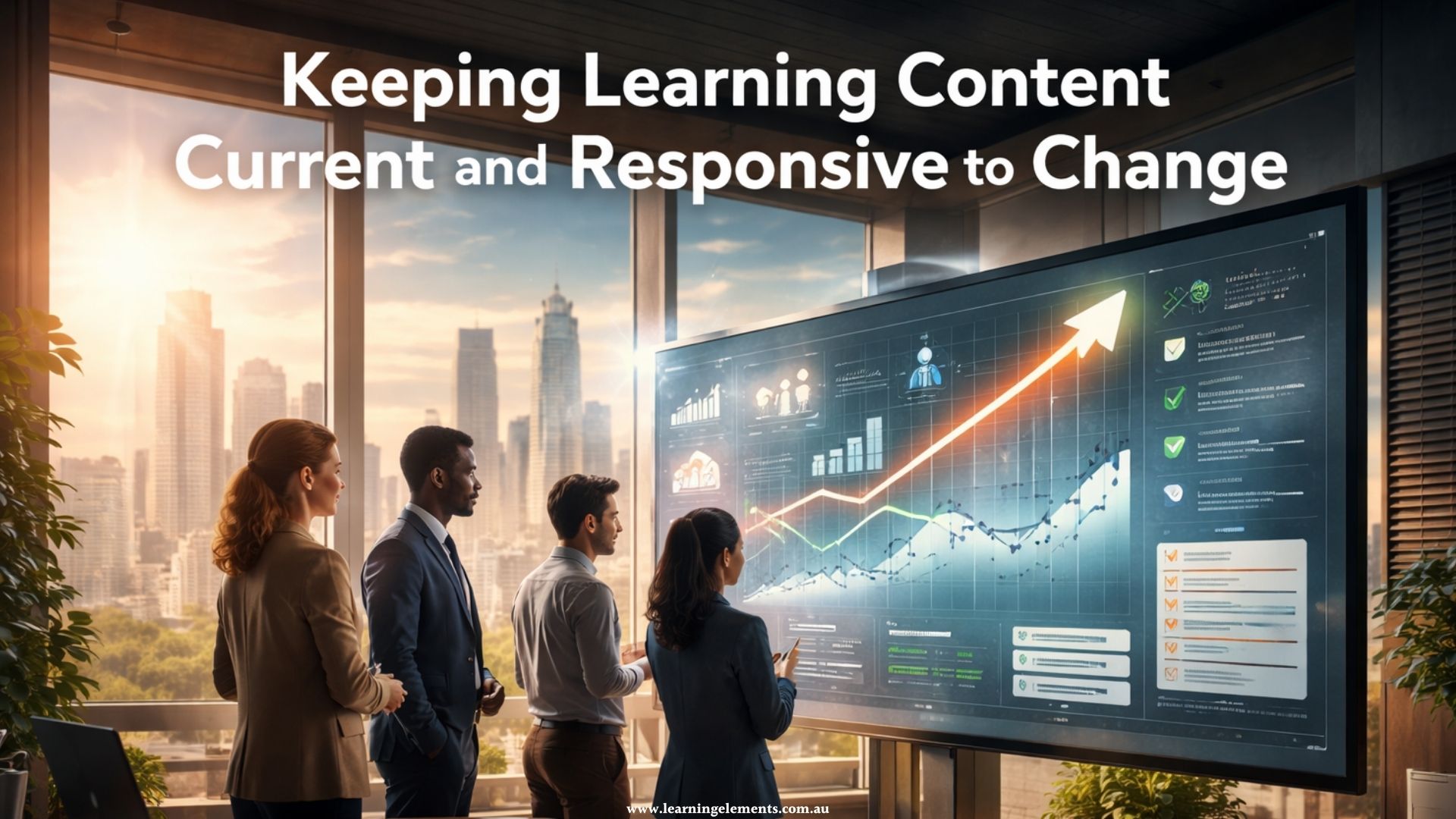
Keeping Learning Content Current and Responsive to Change
Keeping learning content responsive and current is therefore not just a task but a strategic priority for modern organisations. New technologies emerge rapidly. Regulatory requirements evolve. Market conditions shift. Organisational priorities change direction.
Yet learning programs are often developed as if they are static products, carefully built, launched, and then left untouched for months or even years.
The result? Training quickly becomes outdated, misaligned with business strategy, and less relevant to employees’ day-to-day realities.
For organisations committed to meaningful workforce development, the question is not simply “How do we create training?” but “How do we keep it current and responsive to change?”
Why Training Often Falls Behind Business Change
There are several common reasons learning content struggles to keep pace:
- Long development cycles with heavy approval layers
- Content locked into rigid formats (e.g. static slide decks or PDFs)
- Lack of ownership for ongoing review
- Limited data visibility on what is working or becoming irrelevant
- Insufficient localisation for diverse teams
When business strategy evolves faster than learning content, a disconnect forms. Employees may complete training that no longer reflects the systems they use, the regulations they follow, or the customers they serve. For L&D teams, this can undermine credibility and reduce impact.
The Cost of Outdated Training
When learning material becomes obsolete or misaligned, organisations experience:
- Reduced learner engagement
- Lower credibility of the L&D function
- Increased compliance risk
- Skill gaps in critical areas
- Wasted investment in development
Employees quickly recognise when training no longer reflects their tools, systems, regulations, or customer realities. When engagement drops, impact follows.

Benefits of Keeping Learning Content Current
Keeping learning content current delivers measurable advantages across the organisation.
When content reflects the latest priorities, employees focus on developing capabilities that directly support organisational goals. This ensures training investment contributes to performance rather than becoming disconnected from operational reality.
Employees quickly recognise outdated examples, obsolete systems, or irrelevant case studies. Current and contextualised content demonstrates that the organisation understands their working environment, which increases credibility and participation.
In sectors affected by regulatory change, outdated training can create serious risk. Regular updates ensure policies, procedures, and compliance guidance remain accurate and defensible.
Whether implementing new technology, entering new markets, or restructuring teams, responsive learning enables faster adaptation. Training becomes a driver of change rather than a bottleneck.
Current content can be adapted more effectively for different regions and functions. This ensures examples, language, and scenarios are role appropriate and culturally sensitive, particularly for organisations with geographically dispersed teams.
When learning remains relevant, it continues to generate value over time. Programs do not require complete redevelopment, only targeted updates, which protects both time and budget.
If your organisation is experiencing shifting priorities, regulatory change, or evolving technologies, your learning strategy must adapt just as quickly. Ensure your training remains aligned, relevant, and performance-driven.
Shifting from Static Programs to Responsive Solutions
Keeping learning content responsive and current requires more than periodic updates. It calls for a systemic approach that integrates instructional design, technology, governance, and facilitation.
1. Design for adaptability from the outset
Agile content begins with agile design. Instead of building large, inflexible courses, structure learning into modular components aligned to competencies and outcomes. This enables:
- Faster updates to specific sections
- Easier replacement of outdated examples or policies
- Rapid alignment with new technologies or tools
Modular design also supports microlearning and targeted refreshers, which are particularly useful when regulations or internal processes change quickly.
2. Establish clear review cycles and ownership
Content becomes outdated when no one is accountable for maintaining it. Organisations benefit from implementing:
- Scheduled quarterly or biannual reviews
- Clear content ownership within L&D or business units
- SME validation for technical or regulatory material
- Formal triggers for updates following strategic shifts
This structured governance ensures content remains aligned to evolving priorities.
3. Use LMS data to detect relevance gaps
A well-configured Learning Management System can provide early warning signs that content needs refreshing. Indicators may include:
- Declining completion rates
- Lower assessment performance
- Reduced engagement time
- Feedback referencing outdated tools or examples
By analysing these trends, organisations can prioritise updates before impact declines further. When LMS reporting is aligned to strategic KPIs, learning data becomes a powerful driver of improvement rather than a passive record of activity.
4. Use AI to accelerate content updates
AI can support content responsiveness when guided by strong instructional design principles.
Prompts to improve AI in training
Examples of practical AI prompts include:
“Update this compliance module to reflect the latest regulatory requirements in Australia.”
“Revise this case study to incorporate the new CRM system introduced this quarter.”
“Identify sections of this leadership program that may be outdated based on recent industry developments.”
AI can help summarise regulatory changes, suggest refreshed examples, or reframe content for different audiences. However, it should complement, not replace, expert review and contextual judgement.
Addressing Content Localisation and Relevance
Keeping content current is not only about regulation and technology. It is also about context.
Organisations operating across regions, departments, or functions must ensure that training is:
- Contextually relevant
- Culturally appropriate
- Aligned to local regulations and practices
- Tailored to specific roles and responsibilities
Localisation goes beyond translation. It involves adapting scenarios, case studies, terminology, and compliance references so they resonate with learners’ real working environments.
For example:
- Regulatory training may need region-specific references.
- Sales programs may require local market scenarios.
- Leadership development may need contextual examples reflecting organisational structure and cultural expectations.
When employees recognise their context within the training, engagement and retention improve significantly.
How Learning Elements Supports Responsive Learning
Learning Elements partners with organisations to:
- Design modular, update-friendly learning programs
- Align training to shifting business priorities
- Configure LMS platforms for rapid content updates and reporting
- Embed AI thoughtfully to streamline refresh cycles
- Ensure accessibility and inclusive localisation
- Support facilitators in contextual delivery
Outdated content reduces engagement and weakens impact. Discover how a responsive learning framework can protect your investment and strengthen workforce capability.
Integrating Instructional Design, Facilitation and Technology
Responsive content is most effective when supported by an integrated learning strategy.
- Instructional design ensures content is built for adaptability and measurable outcomes.
- Facilitation allows real-time contextualisation during workshops or virtual sessions.
- LMS configuration enables rapid updates, version control, and targeted distribution.
- Analytics and reporting provide insight into impact and emerging skill gaps.
- Governance and ownership require clear responsibility for ongoing review and update cycles.
- Continuous feedback. Learners and managers should be encouraged to flag outdated or irrelevant content.
Organisations that align these elements create a learning solution that evolves alongside business change.
Building Organisational Agility Through Learning
When learning content remains responsive and current, organisations benefit from:
- Faster alignment with strategic priorities
- Reduced compliance risk
- Higher learner trust and engagement
- Stronger workforce capability
- Improved return on investment in training

Keeping Learning Content Current Requires Executive Ownership
Keeping learning content current is not solely the responsibility of L&D teams. While instructional design, facilitation, and LMS configuration are critical enablers, sustainable responsiveness depends on leadership accountability.
When executive leaders treat learning as a strategic lever rather than a support function, content review and refresh cycles become embedded into business planning processes. Regulatory updates, technology implementation, structural change, and market repositioning are then reflected in learning programs as part of structured change management rather than reactive revision.
Executive ownership ensures that:
- Learning priorities align with strategic objectives
- Budget allocation supports ongoing updates, not one-off builds
- Subject matter experts are available for validation
- Learning metrics are reviewed alongside operational KPIs
Without senior sponsorship, even well-designed learning frameworks can stagnate. With it, keeping learning content current becomes a shared organisational responsibility that strengthens long-term capability.
Conclusion
Keeping content current is no longer optional. It is important for maintaining workforce capability in a changing market. Training that adapts to new technologies, evolving regulations, and shifting business priorities does more than transfer knowledge. It builds resilience, relevance, and long-term organisational strength.
If your organisation is experiencing outdated training, localisation challenges, or slow content refresh cycles, it may be time to rethink not just the content itself, but the system that sustains it.
FAQs
Keeping learning content current ensures training reflects real business priorities, regulatory requirements, and operational realities. This strengthens engagement, reduces compliance risk, and improves return on investment.
Most organisations benefit from quarterly or biannual review cycles. High-risk or regulated industries may require more frequent updates triggered by policy or legislative changes.
Common causes include long development cycles, lack of ownership, limited LMS data analysis, rigid formats, and failure to align content with shifting business strategy.
Updating content ensures information remains accurate and aligned to current priorities. Localising content ensures it is contextually relevant, culturally appropriate, and role-specific for different regions or functions.
By integrating instructional design, facilitation, LMS configuration, governance, analytics, and continuous feedback into a unified learning strategy that supports ongoing adaptation.


About Post Author
