


Training Reporting Solutions That Support Custom KPIs
As organisations place greater emphasis on learning impact, compliance, and workforce capability, standard training reports are no longer enough. Leaders increasingly require insight that aligns training data with business priorities, risk exposure, and performance outcomes. This is where training reporting solutions that support custom KPIs become essential.
This article explores what custom KPI-enabled training reporting solutions are, why they matter, the types available, a structured approach to selection, common challenges, best practices, future trends, and how Learning Elements can support organisations in designing meaningful reporting frameworks.
What Are Training Reporting Solutions with Custom KPIs?
Training reporting solutions with custom KPIs allow organisations to define, track, and report on learning metrics that reflect their specific goals, risks, and operating context.
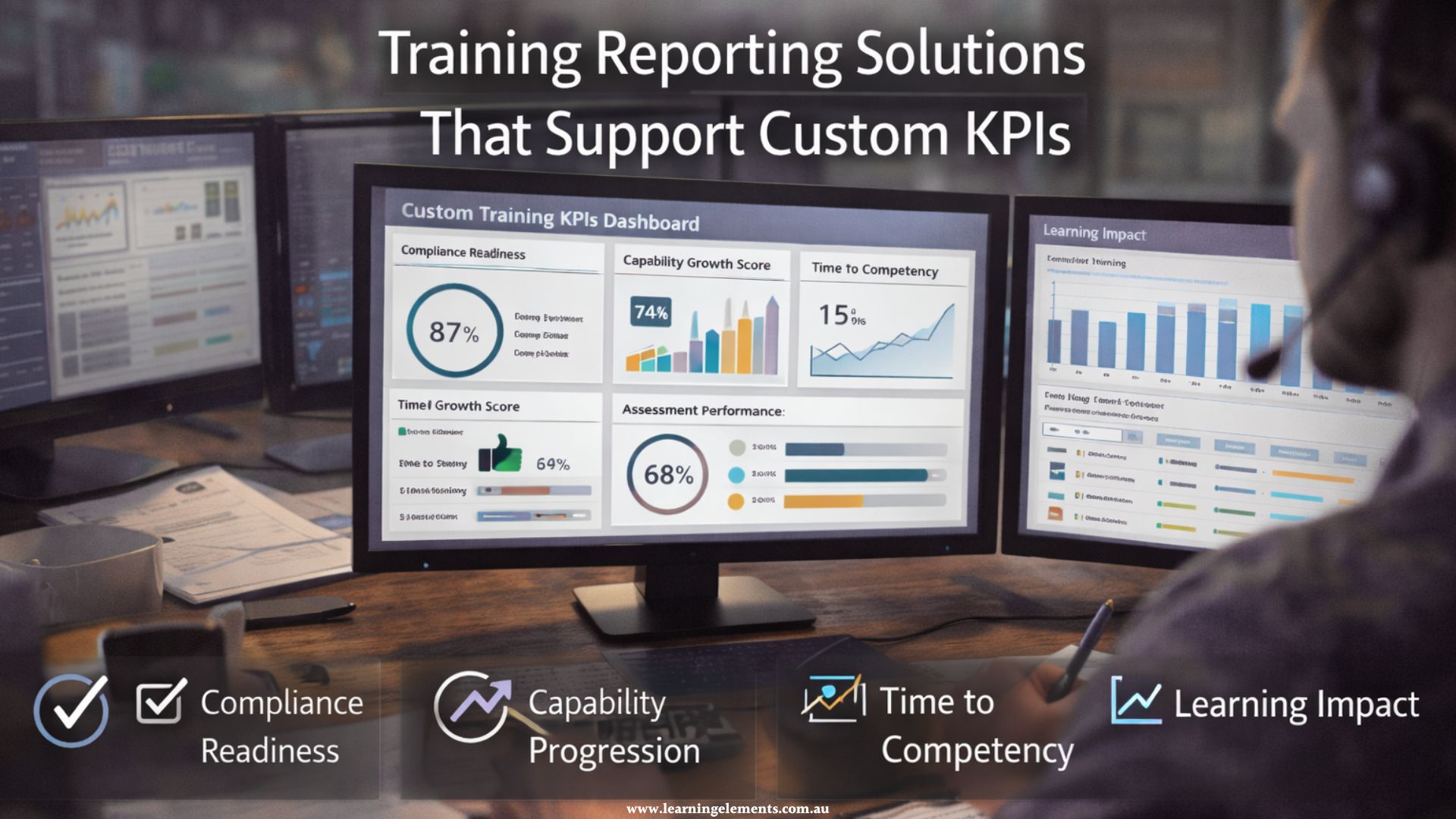
Instead of relying on fixed or generic metrics, these solutions enable reporting on indicators such as:
- Role-specific compliance readiness
- Capability or competency progression
- Time-to-competence for key roles
- Assessment performance trends
- Learning impact linked to operational or safety outcomes
Custom KPIs transform training reports from administrative outputs into strategic decision-support tools.
Why Custom KPI Reporting Matters
Standard training reports typically focus on what is easy to measure, not what is most meaningful. While completion rates are useful, they rarely tell the full story.
Training reporting solutions that support custom KPIs help organisations to:
- Align learning data with business and risk priorities
- Demonstrate training impact beyond attendance
- Support compliance, governance, and audit requirements
- Enable targeted intervention where gaps exist
- Strengthen accountability across L&D, HR, and management
This approach builds on concepts discussed in our related articles such as How to create automated training reports for employee progress and Training reporting dashboards that integrate with LMS systems.
Types of Training Reporting Solutions That Support Custom KPIs
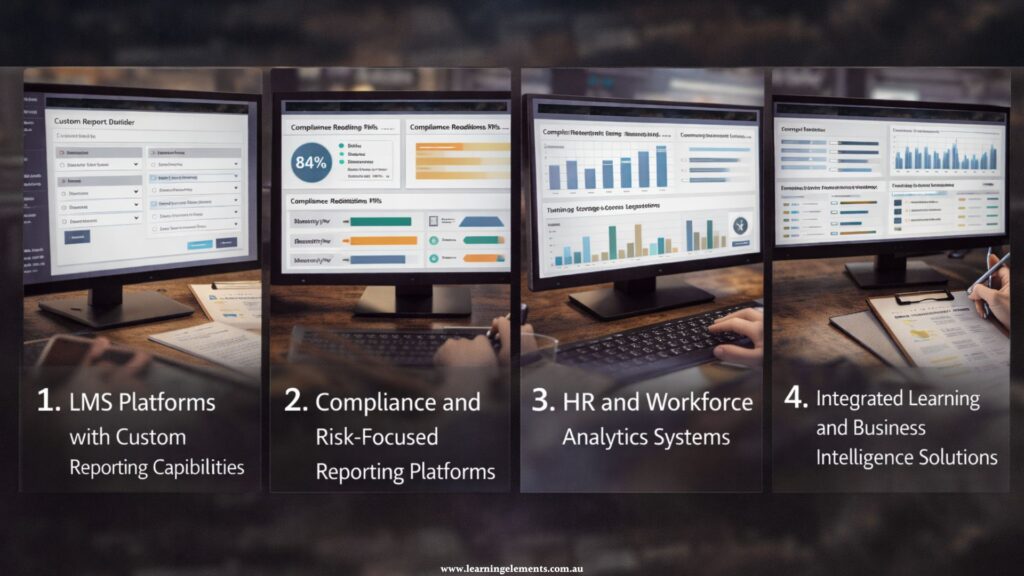
1. LMS Platforms with Custom Reporting Capabilities
Many modern LMS platforms allow organisations to create custom reports and dashboards using configurable data fields.
These solutions typically support:
- Custom completion and assessment metrics
- Role- or group-based reporting
- Automated KPI dashboards
They are suitable for organisations with moderate reporting complexity and clear KPI definitions.
2. Compliance and Risk-Focused Reporting Platforms
Some reporting solutions are designed specifically to support regulatory, safety, or risk-related KPIs.
Common features include:
- Compliance readiness indicators
- Expiry and recertification KPIs
- Audit-focused reporting views
These tools are often used in regulated environments and align well with compliance-focused reporting frameworks.
3. HR and Workforce Analytics Systems
HR platforms with learning analytics capabilities allow training KPIs to be linked with workforce data.
This enables reporting on:
- Capability by role or workforce segment
- Training coverage across locations or sites
- Correlation between training and workforce outcomes
These solutions are powerful but require strong data governance.
4. Integrated Learning and Business Intelligence Solutions
Advanced organisations use enterprise analytics tools that integrate LMS, HR, and operational data.
This allows for:
- Highly customised KPI frameworks
- Executive-level dashboards
- Cross-system insights
While flexible, this approach requires careful design and specialist expertise.
Clear, well-defined KPIs are the foundation of effective training reporting. If your organisation is relying on generic metrics or unclear dashboards, a structured approach to KPI design can unlock far greater insight and value.
A Structured Approach to Selecting Training Reporting Solutions with Custom KPIs
Step 1: Define What Success Looks Like
Start by identifying what learning success means for your organisation. KPIs should align with learning objectives, compliance obligations, and business priorities, rather than generic activity measures.
At this stage, organisations should clarify:
- What outcomes training is expected to achieve
- How success will be recognised or evidenced
- Which risks or performance gaps training is intended to address
Defining success upfront ensures KPIs measure meaningful progress, not just participation. It also prevents reporting frameworks from becoming overly complex or misaligned with organisational goals.
Step 2: Map KPIs to Data Sources
Actively identify where each KPI’s data will come from and confirm that it can be consistently and accurately captured from existing systems, such as the LMS, HR platform, or assessment tools. This approach enables teams to anchor KPIs in reliable data sources and report with confidence, without relying on manual workarounds or assumptions.
This step requires confirming:
- Where each data point originates
- How consistently the data is captured
- Whether data definitions are standardised across systems
If KPIs cannot be supported by reliable data, reports will lack credibility. Mapping KPIs to data sources early helps identify gaps, configuration issues, or the need for integration before reporting is implemented.
Step 3: Design Role-Based KPI Views
Different stakeholders require different insights. Executives, managers, and L&D teams should not see identical dashboards.
Effective role-based KPI views ensure that:
- Executives see high-level trends, risk indicators, and readiness summaries
- Managers see team-level performance and action prompts
- L&D teams see detailed learning and assessment analytics
This approach improves usability, reduces information overload, and increases the likelihood that KPI data will be acted on.
Step 4: Automate KPI Reporting Where Possible
Automation reduces manual effort, improves accuracy, and ensures reports remain current.
Where possible, training reporting solutions should:
- Refresh KPI data automatically
- Schedule recurring reports or dashboards
- Trigger alerts for defined thresholds or risks
Automated reporting minimises reliance on spreadsheets and manual intervention, supporting timely decision-making and consistent governance.
Step 5: Review and Refine KPIs Over Time
KPIs should evolve as organisational priorities, skills frameworks, and regulatory requirements change.
Regular review ensures that:
- KPIs remain relevant and meaningful
- Redundant or low-value metrics are removed
- New risks, roles, or capabilities are reflected in reporting
Treating KPIs as a living framework helps maintain long-term value and prevents reporting from becoming outdated or misaligned.
Common Challenges with Custom KPI Training Reporting
Organisations frequently encounter challenges such as:
- Poorly defined KPIs that lack instructional or business relevance
- Data quality issues due to inconsistent system configuration
- Overly complex dashboards that reduce usability
- KPIs that focus on activity rather than capability
These challenges mirror issues explored in How to troubleshoot common issues with training report generation.
Best Practices for Custom KPI Training Reporting
- Start with instructional design, not technology
- Limit KPIs to what drives decision-making
- Combine quantitative data with qualitative insight
- Ensure accessibility and clarity in dashboards
- Establish clear ownership and governance
Using AI to Enhance Custom KPI Reporting
AI can support KPI reporting by:
- Identifying patterns across large datasets
- Highlighting emerging capability or compliance risks
- Summarising KPI performance for leaders
How Learning Elements Can Support You
Learning Elements supports organisations to design training reporting solutions that move beyond basic metrics.
Support includes:
- Defining meaningful learning and compliance KPIs
- Configuring LMS and reporting tools
- Designing role-based dashboards
- Ensuring accessibility, inclusion, and localisation
- Turning KPI data into actionable insight
Designing meaningful KPIs and dashboards requires alignment between learning design, data structure, and organisational decision-making. Expert guidance can help ensure your reporting solutions support real outcomes rather than surface-level metrics.

Future Trends
- Greater focus on skills-based KPIs
- Predictive analytics linked to risk and readiness
- Deeper integration with performance and governance systems
Conclusion
Training reporting solutions that support custom KPIs enable organisations to measure what truly matters, rather than relying on generic metrics that offer limited insight. By moving beyond basic completion data and aligning reporting with learning design, compliance obligations, and business outcomes, organisations gain clearer visibility into capability, risk, and workforce readiness.
As a result, training data becomes more than an administrative record. It becomes a strategic asset that supports informed decision-making, strengthens governance, and demonstrates the real value of learning investment. With the right structure, systems, and expertise in place, organisations can ensure their reporting evolves alongside changing priorities and regulatory expectations.
If you want training reporting solutions that support custom KPIs aligned to your organisation’s goals, compliance needs, and workforce strategy, a structured, expert-led approach makes all the difference.
FAQs
They are organisation-specific metrics that measure learning impact, capability, or compliance beyond basic completion.
Yes. Many LMS platforms offer scalable custom reporting options.
Organisations identify effective KPIs by aligning learning objectives with business priorities, risk exposure, and compliance requirements. Fewer, clearly defined KPIs deliver more value than large volumes of data.
Yes. Training reporting solutions allow organisations to review and refine KPIs as business needs, regulations, or skills frameworks evolve.
L&D specialists, compliance or risk leaders, business managers, and senior stakeholders should define training KPIs together to ensure relevance, accountability, and strategic alignment.


About Post Author
