



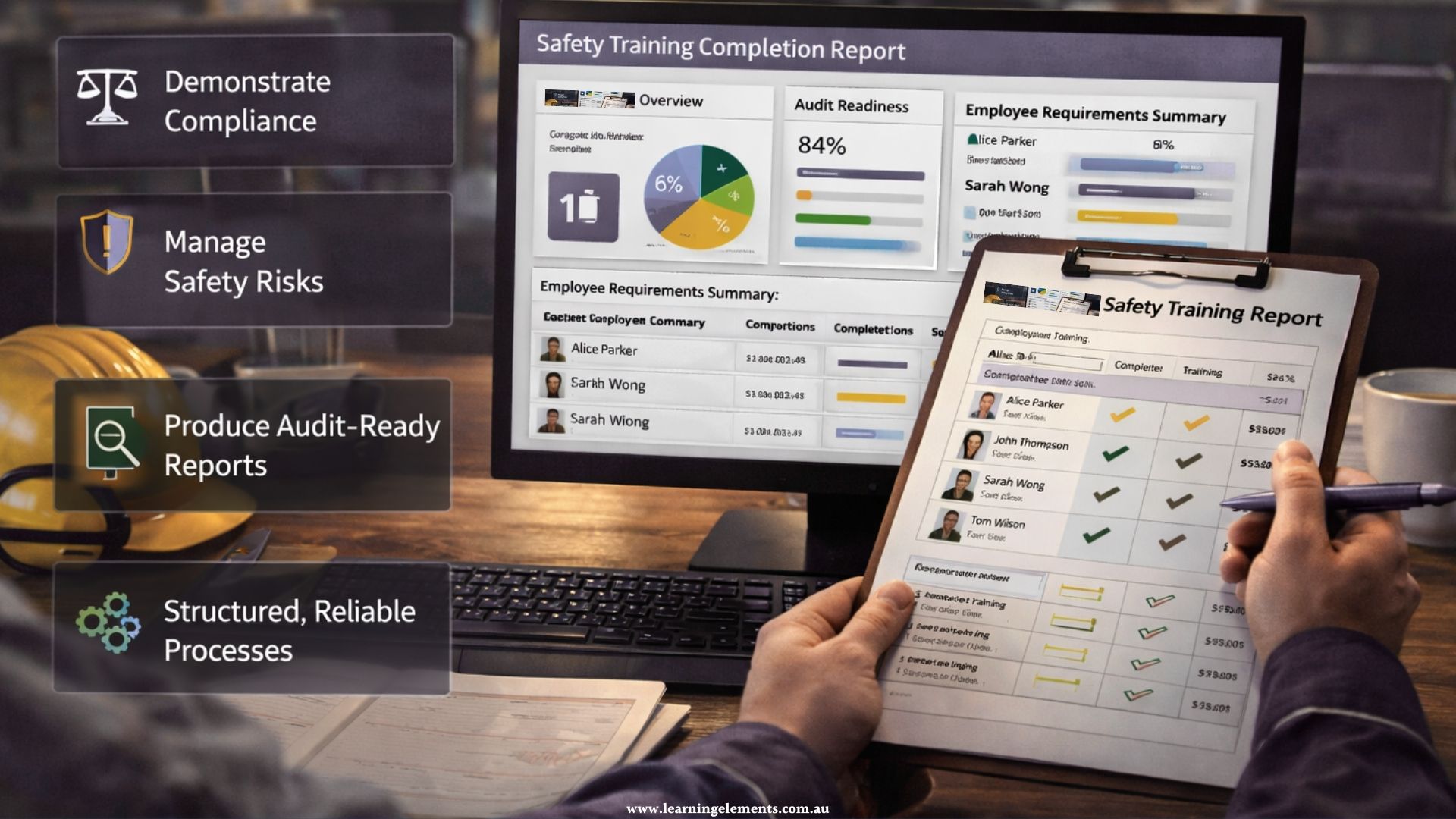
How to Generate Training Completion Reports for Workplace Safety
Training completion reports for workplace safety play a critical role in compliance, risk management, and organisational accountability. When generated effectively, they provide clear evidence of due diligence, support audits and investigations, and enable proactive safety management. Workplace safety training is a legal and ethical responsibility for organisations operating in regulated and high-risk environments. However, delivering safety training alone is not enough. Organisations must also be able to demonstrate, evidence, and report that training has been completed, understood, and maintained over time.
This article explains how to generate training completion reports for workplace safety, outlines a structured approach, highlights common challenges and best practices, explores future trends, and explains how Learning Elements can support organisations in building reliable, audit-ready reporting processes.
What Is a Training Completion Report for Workplace Safety?
A training completion report for workplace safety is a structured record that shows:
- Who has completed required safety training?
- What training was completed?
- When it was completed?
- Whether certification or assessment requirements were met
- Whether refresher or renewal training is required
These reports are typically generated from:
- Learning Management Systems (LMS)
- Compliance or safety training platforms
- Integrated HR or workforce systems
When designed well, they provide clear, audit-ready evidence rather than fragmented or manual records
Why Training Completion Reports Matter for Workplace Safety
Safety training completion reports are more than administrative documents. They are a core component of an organisation’s safety and governance framework.
Effective safety training reports help organisations to:
- Demonstrate compliance with workplace health and safety (WHS) obligations
- Provide evidence during audits, inspections, or incidents
- Monitor whether mandatory safety training has been completed on time
- Identify gaps in coverage across roles, sites, or risk levels
- Support managers in meeting their duty of care
For Australian organisations, particularly those operating under WHS legislation, the ability to generate accurate and timely training completion reports is essential to reducing legal, operational, and reputational risk.
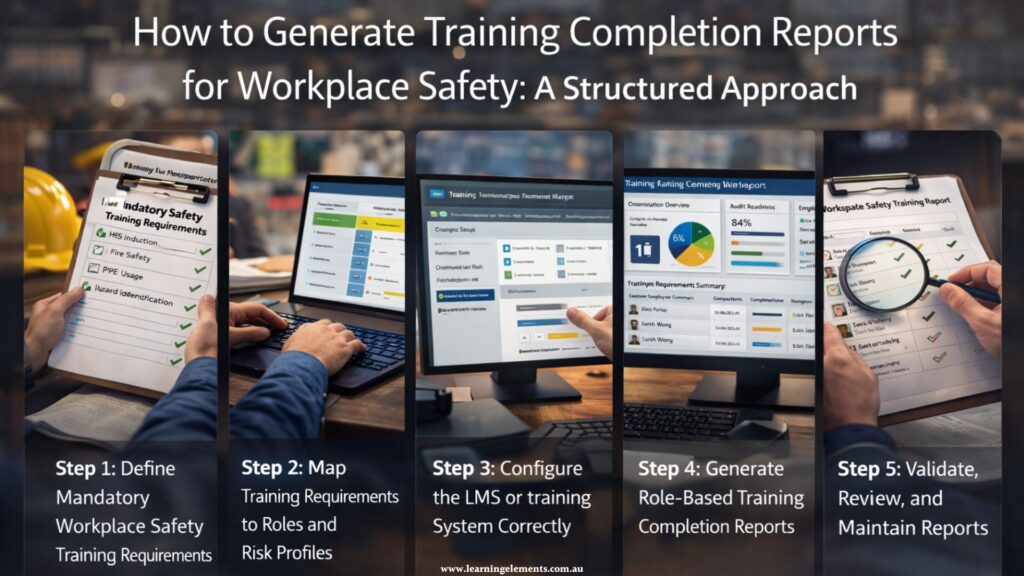
How to Generate Training Completion Reports for Workplace Safety: A Structured Approach
To ensure training completion reports are accurate, defensible, and useful, organisations should follow a structured approach. Workplace safety reporting is not simply about producing a list of completed courses; it is about creating reliable evidence that training obligations have been met, risks are being managed, and due diligence can be demonstrated if required.
A structured approach helps organisations move away from ad hoc or manual reporting and towards consistent, system-driven processes that stand up to audits, regulatory scrutiny, and internal governance reviews. It also ensures that training completion data supports proactive safety management, rather than serving as a reactive or administrative task.
Step 1: Define Mandatory Workplace Safety Training Requirements
Purpose of this step: To establish exactly what safety training must be reported.
Organisations should identify:
- Legislative and regulatory safety training requirements
- Industry or site-specific safety obligations
- Internal safety policies and procedures
- Role-based or risk-based training expectations
This includes understanding:
- Which courses are mandatory
- Who must complete them
- How often refresher training is required
Clear definition prevents gaps and inconsistent reporting.
Step 2: Map Training Requirements to Roles and Risk Profiles
Purpose of this step: To ensure reports reflect real workplace risk.
Safety training completion reports should show compliance by:
- Job role
- Work location or site
- Hazard exposure or risk level
For example, high-risk roles may require additional or more frequent training than office-based roles.
This alignment ensures reports support meaningful safety oversight rather than generic completion statistics.
Step 3: Configure the LMS or Training System Correctly
Purpose of this step: To ensure data captured is reliable and reportable.
Systems should be configured to:
- Track enrolment, progress, and completion accurately
- Record assessment results where required
- Capture completion dates and expiry periods
- Apply consistent naming and course structures
Poor configuration is one of the most common causes of unreliable safety reporting.
Step 4: Generate Role-Based Training Completion Reports
Purpose of this step: To provide the right information to the right stakeholders.
Effective workplace safety reports typically include:
- Organisation-wide compliance summaries
- Manager-level team completion reports
- Individual learner completion records
- Audit-ready evidence reports
Reports should clearly indicate:
- Completed training
- Outstanding or overdue requirements
- Upcoming renewals
This enables proactive intervention before safety risks escalate.
Step 5: Validate, Review, and Maintain Reports
Purpose of this step: To ensure ongoing accuracy and audit readiness.
Organisations should:
- Regularly review report logic and rules
- Validate data accuracy against source systems
- Update reports as training or regulations change
- Retain records in line with legislative requirements
Safety reporting is not a one-off task. It requires ongoing governance.
Clear, accurate training completion reports are critical to demonstrating workplace safety compliance and reducing organisational risk. If your reporting relies on manual tracking, spreadsheets, or inconsistent LMS data, it may be time to take a more structured, defensible approach.
Learning Elements works with organisations to design safety training reporting processes that are reliable, audit-ready, and aligned to real workplace risk.
Common Challenges in Generating Workplace Safety Training Reports
Even when organisations have LMS platforms or safety training systems in place, producing reliable workplace safety training reports remains a persistent challenge. These issues are rarely caused by a lack of technology alone. More often, they arise from how systems are configured, how learning is designed, and how responsibility for safety reporting is shared across the organisation.
Understanding these challenges in detail is essential to building more mature, defensible safety reporting practices.
Incomplete or Inaccurate Data
One of the most significant barriers to effective workplace safety reporting is data quality. Safety training data may be incomplete, inconsistent, or unreliable due to poor system setup or fragmented processes.
This commonly occurs when:
- Training records are spread across multiple systems
- Course structures are inconsistent or frequently changed
- Learner data is outdated or incorrectly linked to roles or sites
- Completion rules or assessment criteria are unclear
When safety reports are generated from weak or inconsistent data, they may fail to accurately represent who is trained, who is at risk, or where gaps exist.
Why this matters: Inaccurate data undermines confidence in safety reporting, weakens audit readiness, and can expose organisations to regulatory or legal risk. Leaders may assume safety obligations have been met when, in reality, critical training gaps remain.
Over-Reliance on Completion Alone
Many workplace safety reports focus almost exclusively on whether training has been “completed”. While completion is easy to track, it provides limited insight into whether learning objectives have been achieved.
Completion data often fails to answer key safety questions, such as:
- Did the learner understand the safety procedure?
- Can they apply the training correctly in their role?
- Has competence been demonstrated or assessed?
In high-risk or regulated environments, attendance or completion does not necessarily equate to safe behaviour or capability.
Why this matters: Over-reliance on completion metrics can create a false sense of security. Organisations may appear compliant on paper while remaining exposed to operational and safety risks due to unverified competence.
Manual Workarounds and Shadow Systems
Despite having digital systems, many organisations still rely on spreadsheets, emails, or manual registers to track safety training. These workarounds often emerge when reporting tools are poorly configured or difficult to use.
Manual processes typically involve:
- Copying data between systems
- Maintaining parallel records “just in case”
- Chasing completion via email
- Updating reports manually for audits
While these approaches may seem practical in the short term, they introduce significant risk.
Why this matters: Manual tracking increases the likelihood of errors, delays, and version control issues. It also places unnecessary administrative burden on L&D, HR, or safety teams and reduces confidence in the accuracy of reports during audits or investigations.
Limited Visibility for Managers and Supervisors
Workplace safety depends heavily on frontline leadership, yet managers often lack timely or meaningful access to safety training data.
This can happen when:
- Reports are designed only for L&D or compliance teams
- Dashboards are overly complex or technical
- Data is not filtered by team, role, or site
- Managers are unsure how to interpret or act on reports
Without clear visibility, managers may not recognise emerging risks or overdue training until issues escalate.
Why this matters: When managers cannot easily see safety training status, opportunities for early intervention are missed. This weakens accountability, increases reliance on central teams, and can contribute to preventable safety incidents.
Best Practices for Workplace Safety Training Completion Reports
Organisations should apply the following best practices:
- Align reports to WHS and safety risk frameworks
- Combine completion data with assessment or competency evidence
- Use clear, plain language in reports
- Automate reporting and alerts where possible
- Ensure reports are accessible and easy to interpret
- Review reports regularly as safety requirements evolve
Strong reporting supports both compliance and continuous safety improvement.
Using AI to Enhance Workplace Safety Training Reporting
AI can add value to safety reporting when used responsibly.
Examples include:
- Identifying patterns of non-compliance across sites or roles
- Highlighting overdue or high-risk training gaps
- Summarising safety training status for leaders
Example AI Prompts for Safety Reporting
- “Identify high-risk roles with overdue safety training.”
- “Summarise workplace safety training completion by site.”
- “Highlight trends in repeated non-compliance and recommend actions.”
AI should support insight and prioritisation, not replace human accountability for safety.
How Learning Elements Can Support You
Generating training completion reports for workplace safety requires more than technical reporting. It requires alignment between instructional design, compliance requirements, system configuration, and organisational risk management.
Learning Elements supports organisations by:
- Designing safety training with measurable outcomes
- Configuring LMS platforms for accurate safety reporting
- Developing audit-ready training completion reports
- Ensuring accessibility, inclusion, and localisation
- Turning safety training data into actionable insight
Whether you are strengthening WHS compliance, preparing for audits, or improving safety visibility, Learning Elements helps ensure your reporting processes are reliable, defensible, and fit for purpose.

Future Trends
As workplace safety expectations evolve, so too does the way organisations use training data. Safety reporting is shifting from retrospective compliance evidence towards proactive risk management and continuous improvement.
The following trends are shaping the future of workplace safety training reporting.
Predictive Safety Analytics
Rather than simply reporting what has already happened, organisations are beginning to use training data to anticipate future risk.
Predictive safety analytics may:
- Identify roles or sites at higher risk of non-compliance
- Highlight patterns of repeated overdue training
- Flag areas where refresher training may be required sooner
- Support proactive safety interventions
Why this matters: Predictive reporting enables organisations to act before incidents occur, strengthening their duty of care and reducing reliance on reactive compliance measures.
Skills and Competency-Based Reporting
There is a growing shift away from attendance-based reporting towards evidence of capability.
Future-focused safety reporting increasingly includes:
- Assessment results and practical demonstrations
- Competency frameworks linked to safety-critical roles
- Ongoing verification of skills, not one-off completion
This approach aligns safety training more closely with real-world performance.
Why this matters: Demonstrating competence provides stronger assurance than completion alone, particularly in environments where incorrect application of safety procedures can have serious consequences.
Integration with Safety and Risk Systems
Workplace safety training reports are becoming more connected to broader organisational systems, such as:
- Incident reporting platforms
- Risk registers
- Hazard and control management systems
This integration allows organisations to:
- Link training gaps to incident trends
- Prioritise training based on risk exposure
- Provide a more holistic view of safety performance
Why this matters: Integrated reporting strengthens governance and supports evidence-based safety decision-making across the organisation.
Personalised and Role-Based Safety Reporting
Future safety reporting is becoming more targeted and user-specific.
This includes:
- Role-based dashboards for managers and supervisors
- Personalised reminders and alerts for workers
- Simplified executive views focused on risk and readiness
Rather than one-size-fits-all reports, safety insights are tailored to who needs to act on them.
Why this matters: Clear, relevant reporting improves engagement, accountability, and timely action, making safety reporting a practical tool rather than a static record.
Why These Developments Matter for Organisations
Together, these trends reflect a broader shift in workplace safety reporting:
- From reactive to proactive
- From compliance-only to capability-focused
- From centralised control to shared accountability
Organisations that embrace these changes are better positioned to demonstrate due diligence, protect their workforce, and continuously improve safety outcomes.
Conclusion
Knowing how to generate training completion reports for workplace safety is essential for organisations committed to compliance, accountability, and the wellbeing of their workforce. When built with purpose, supported by well-configured systems, and governed effectively, these reports become a powerful safety and risk management tool.
By taking a structured, expert-led approach, organisations can move beyond basic tracking and ensure their safety training data supports real-world outcomes.
If you are ready to strengthen your workplace safety reporting capability, now is the time to take the next step.
FAQs
It is a report that evidences who has completed required safety training, when it was completed, and whether ongoing requirements are met.
While requirements vary, organisations must be able to demonstrate due diligence and compliance with WHS obligations.
Yes. Many LMS and training platforms support scalable reporting for organisations of all sizes.
No, but it can enhance insight and efficiency when used responsibly.
Training completion reports should be reviewed regularly, particularly for high-risk roles or regulated environments. Many organisations review reports monthly, with more frequent checks where safety risks or compliance obligations are higher.
An audit-ready report should clearly show learner identity, training requirements, completion dates, assessment results (where applicable), certification or expiry dates, and evidence of refresher training. Reports should be easy to verify and trace back to source systems.
Responsibility is typically shared. L&D or HR teams manage system configuration and reporting, while managers are accountable for ensuring their teams complete required training. Clear ownership and governance are essential to maintaining accurate reports.


About Post Author
